
Pre-Employment Aptitude Tests for Recruitment | 2026 Guide for Employers



Aptitude tests are increasingly used in modern recruitment to assess a candidate’s core abilities beyond their CV. These assessments measure general cognitive skills, including numerical and verbal reasoning, problem-solving, critical thinking, and the capacity to learn and adapt to new situations.
Depending on the type of aptitude test, candidates may encounter numerical reasoning questions, verbal comprehension exercises, abstract pattern recognition, and scenario-based problem-solving. Each question type aims to evaluate how quickly and accurately a candidate can analyze information, think logically, and make sound decisions under pressure.
By emphasizing reasoning, analysis, and decision-making skills, aptitude tests allow employers to identify individuals who can manage complex tasks and perform effectively under pressure. This supports data-driven hiring decisions and helps select candidates with strong growth potential, contributing to building resilient, high–performing teams in dynamic work environments.
Keep reading to explore how aptitude tests can help you select top talent.
Contents
- What is an aptitude test?
- What are the different types of aptitude tests for recruitment?
- What is the importance of aptitude tests in hiring?
- At what stage are aptitude tests used in the hiring process?
- How do aptitude tests work as hiring tests in job interviews?
- What are the best practices for including aptitude tests in your selection process?
- Which industries and roles should use aptitude tests for recruitment?
- Which employers use aptitude tests for recruitment?
- Aptitude Tests: Client application story
- Why top companies choose Assess Candidates’ aptitude tests for recruitment
Now that we’ve summarized what this article covers, let’s find out what an aptitude test is.
1. What is an aptitude test?
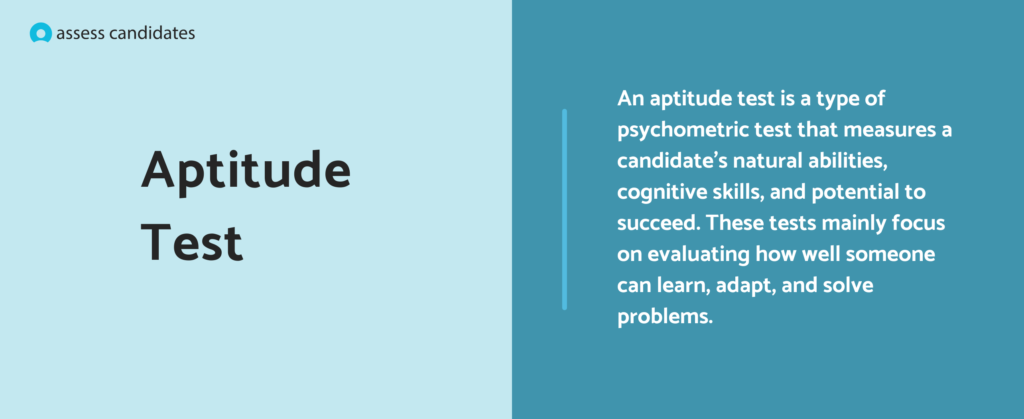
An aptitude test or cognitive ability test is a type of psychometric test that measures a candidate’s natural abilities, cognitive skills, and potential to succeed in specific areas such as numerical, verbal, logical, or spatial reasoning. These tests mainly focus on evaluating how well someone can learn, adapt, and solve problems, making them a valuable tool in recruitment.
Employers often include aptitude tests in the pre-employment hiring process to assess candidates’ technical abilities, critical thinking, and overall suitability for the role, helping them make well-informed decisions when selecting the best-fit applicants.
Did you know? According to a report by Harvard Business Review, 76% of organizations with more than 100 employees rely on assessment tools such as aptitude tests for external hiring.
Enhance your hiring accuracy with our scientifically validated cognitive aptitude tests. HIRE FOR FREE
In the following section, we will take a look at the different types of aptitude tests used in recruitment.

2. What are the different types of aptitude tests for recruitment?
Aptitude tests for recruitment come in various forms, each designed to evaluate specific cognitive abilities and skills. They measure numerical, verbal, logical, and abstract reasoning, as well as problem-solving and learning potential, giving employers a well-rounded view of a candidate’s strengths and suitability for the role.

The following are the main types of aptitude tests used during the hiring process:
1. Numerical Reasoning Test
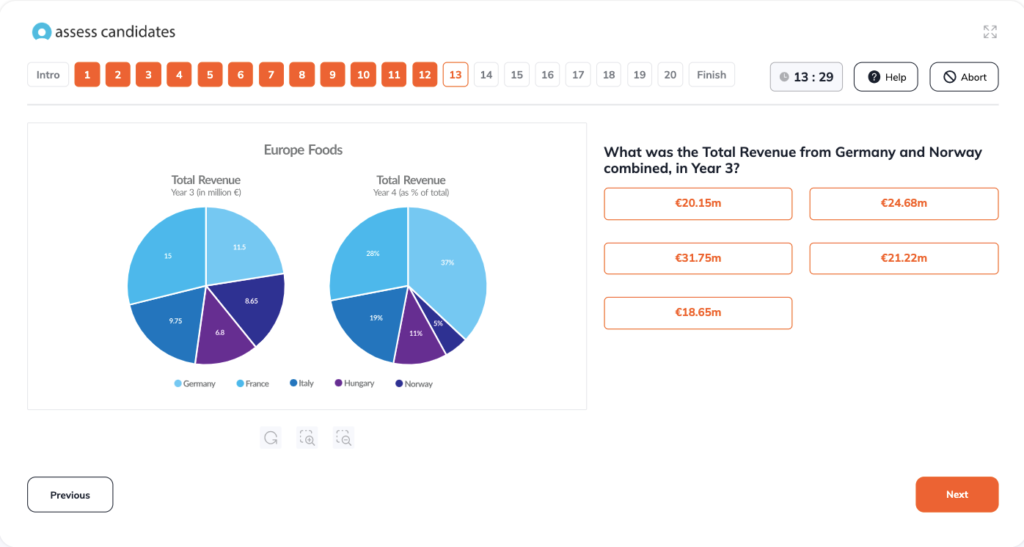
A numerical reasoning test is a pre-employment numerical test that measures a candidate’s ability to interpret data, analyze numbers, and draw accurate conclusions from charts, tables, or graphs.
What skills do numerical reasoning tests measure?
The following are some of the major skills measured by numerical reasoning tests:
- Arithmetic ability: Measures a candidate’s performance in workplace calculations using decimals, fractions, ratios, percentages, and averages.
- Data analysis: Evaluates a candidate’s ability to interpret complex data to identify trends and insights.
- Reading graphs and visualizing data: Assesses a candidate’s understanding of charts, tables, and graphs to extract and communicate insights.
- Problem-solving skills: Measures a candidate’s use of logic and analytical thinking to solve numerical challenges.
Let’s take a look at one of the example Assess Candidates’ off-the-shelf numerical reasoning test questions:
Assess Candidates’ Numerical Reasoning Test Example Question
2. Verbal Reasoning Test
A verbal reasoning test or verbal aptitude test is a type of pre-employment assessment that measures a candidate’s ability to comprehend, analyze, and interpret written information.
What skills do verbal reasoning tests measure?
The following are some of the major skills measured by verbal reasoning tests:
- Verbal comprehension: Measures a candidate’s ability to understand written passages quickly and identify key ideas from reports, documents, and statements.
- Logical reasoning: Evaluates a candidate’s ability to connect information within text to draw accurate, evidence-based conclusions without external assumptions.
- Attention to detail: Assesses a candidate’s ability to spot subtle wording differences and nuances to avoid misinterpretation and ensure accuracy.
- Vocabulary and grammar: Measures a candidate’s ability to use strong vocabulary and grammar to interpret text precisely, distinguish meanings, and communicate clearly.
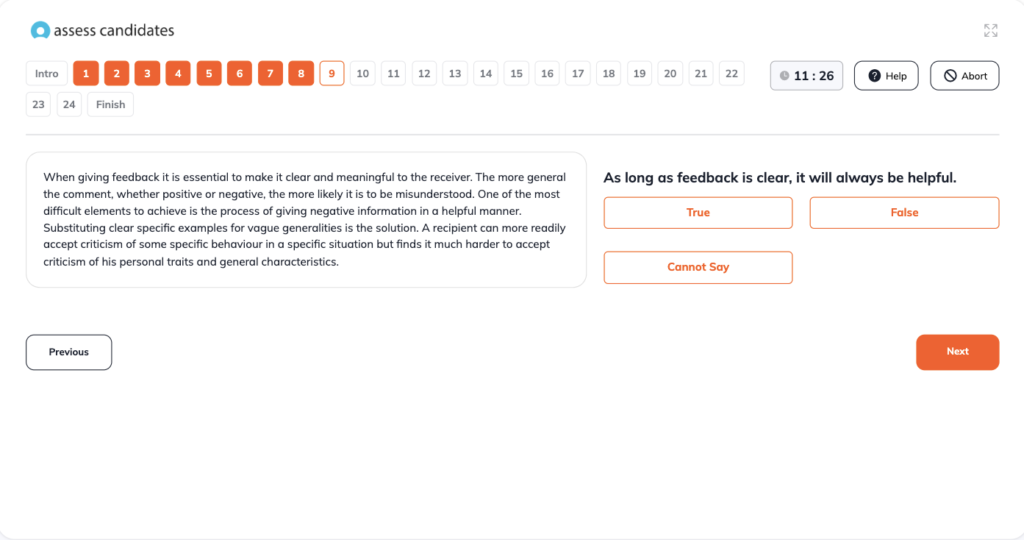
Let’s take a look at one of the example Assess Candidates’ off-the-shelf verbal reasoning test questions:
Assess Candidates’ Verbal Reasoning Test Example Question
3. Logical Reasoning Test
A logical reasoning test, or logical test, is a pre-employment assessment that evaluates problem-solving skills by analyzing abstract information, spotting patterns, and drawing conclusions.
What skills do logical reasoning tests measure?
The following are some of the major skills measured by logical reasoning tests:
- Analytical thinking: Measures a candidate’s ability to break complex problems or data into manageable parts to identify patterns and make evidence-based decisions.
- Pattern recognition: Evaluates a candidate’s ability to identify recurring sequences, rules, or relationships in data, numbers, or visuals.
- Deductive reasoning: Measures a candidate’s ability to apply general rules to reach logically certain and specific conclusions.
- Inductive reasoning: Evaluates a candidate’s ability to draw broader rules or insights from specific observations or repeated patterns.
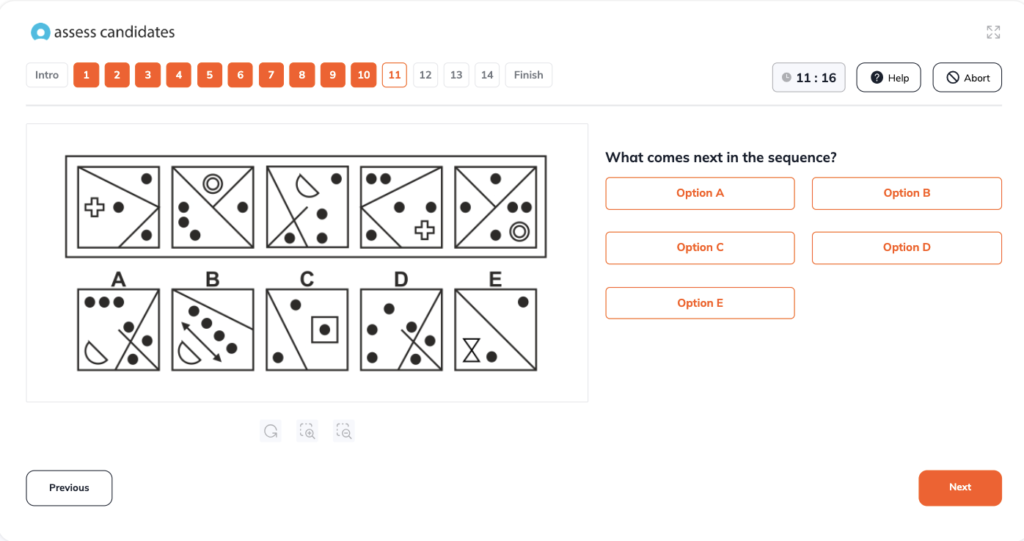
Let’s take a look at one of the example Assess Candidates’ off-the-shelf logical reasoning test questions:
Assess Candidates’ Logical Reasoning Test Example Question
4. Abstract Reasoning Test
An abstract reasoning test is a widely used form of psychometric assessment in recruitment that measures a candidate’s ability to solve problems, grasp new concepts, and identify patterns or relationships in visual information.
What skills do abstract reasoning tests measure?
The following are some of the major skills measured by abstract reasoning tests:
- Pattern recognition: Tests the ability of candidates to identify and interpret recurring sequences or structures in visual data.
- Logical reasoning: Assesses a candidate’s logical thinking skills and the capacity to predict outcomes or draw sound conclusions from given information.
- Problem-solving: Evaluates how effectively candidates can resolve challenges using abstract and visual cues.
- Abstract thinking: Measures the ability of candidates to conceptualize ideas and work with information beyond the tangible.
Let’s take a look at one of the example Assess Candidates’ off-the-shelf abstract reasoning test questions:
Assess Candidates’ Abstract Reasoning Test Example Question
5. Diagrammatic Reasoning Test
A diagrammatic reasoning test is a pre-employment cognitive aptitude test that evaluates a candidate’s ability to interpret visual information, apply logic, and solve problems using shapes, symbols, and patterns.
What skills do diagrammatic reasoning tests measure?
The following are some of the major skills measured by diagrammatic reasoning tests:
- Logical reasoning: Evaluates a candidate’s structured thinking and the ability to analyze sequences and patterns using deductive and inductive reasoning.
- Pattern recognition: Measures how quickly a candidate can identify relationships and patterns in visual data.
- Problem-solving skills: Assesses a candidate’s adaptability and strategic thinking when solving problems with incomplete visual information.
- Attention to detail: Tests the ability of a candidate to spot small details and maintain accuracy in sequences or diagrams.
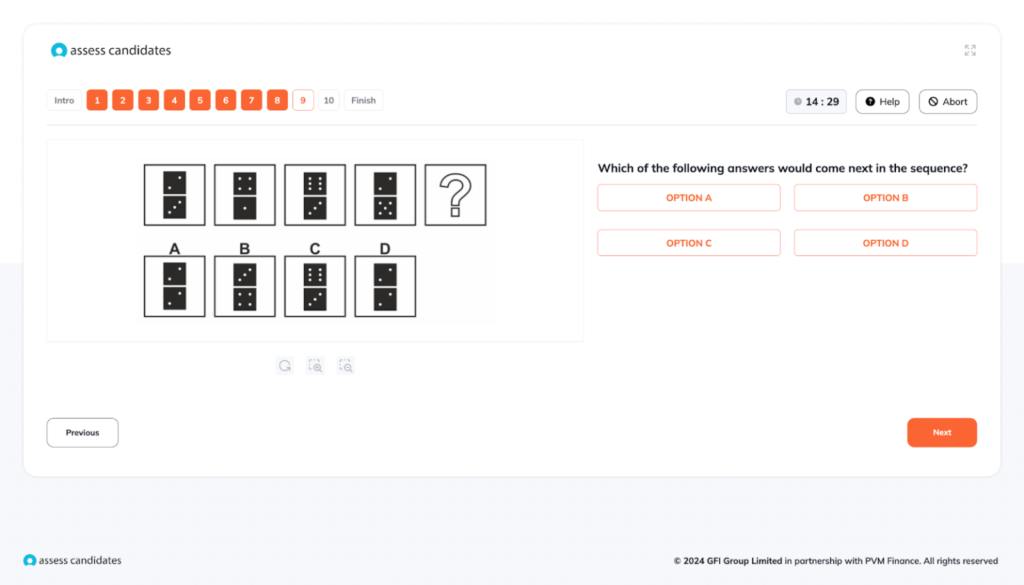
Let’s take a look at one of the example Assess Candidates’ off-the-shelf diagrammatic reasoning test questions:
Assess Candidates’ Diagrammatic Reasoning Test Example Question

6. Spatial Reasoning Test
A spatial reasoning test, also called a spatial awareness test, is a pre-employment assessment that measures a candidate’s ability to interpret and manipulate 2D and 3D shapes, recognize patterns, and visualize object transformations.
What skills do spatial reasoning tests measure?
The following are some of the major skills measured by spatial reasoning tests:
- Spatial perception: Measures a candidate’s ability to understand spatial relationships, navigate spaces, and analyze distances effectively.
- Mental rotation: Assesses a candidate’s ability to visualize 2D or 3D objects from different angles mentally.
- Spatial visualization: Evaluates a candidate’s ability to mentally manipulate, rotate, fold, or twist 2D and 3D objects.
Let’s take a look at one of the example Assess Candidates’ off-the-shelf spatial reasoning test questions:
Assess Candidates’ Spatial Reasoning Test Example Question

7. Situational Judgment Test
A situational judgment test (SJT) is a pre-employment behavioral test that assesses how candidates handle realistic workplace scenarios. It measures practical judgment and key competencies to determine role suitability.
What skills do situational judgment tests measure?
The following are some of the major skills measured by situational judgment tests:
- Decision-making: Assesses a candidate’s ability to process complex information and make sound, confident choices.
- Communication: Evaluates how well a candidate conveys ideas, negotiates, and collaborates with colleagues or clients.
- Teamwork: Looks at a candidate’s approach to collaboration, achieving team goals, and building strong professional relationships.
- Leadership: Assesses a candidate’s leadership qualities, such as guiding teams, resolving conflicts, and motivating others.
Let’s take a look at one of the example Assess Candidates’ off-the-shelf situational judgment test questions:
Assess Candidates’ Situational Judgment Test Example Question
8. Critical Reasoning Test
Critical reasoning tests, also called critical thinking tests, are pre-employment aptitude assessments that measure a candidate’s ability to analyze information and draw logical, well-reasoned conclusions.
What skills do critical reasoning tests measure?
The following are some of the major skills measured by critical reasoning tests:
- Critical reasoning: Measures a candidate’s ability to formulate insightful questions and examine facts to draw logical conclusions.
- Situational awareness: Evaluates a candidate’s ability to analyze situations holistically and reach logical interpretations.
- Emotional intelligence: Examines a candidate’s ability to make decisions based on objective judgment rather than emotional bias.
- Problem-solving: Assesses a candidate’s ability to identify and resolve workplace challenges efficiently.
Let’s take a look at one of the example Assess Candidates’ off-the-shelf critical reasoning test questions:
Assess Candidates’ Critical Reasoning Test Example Question
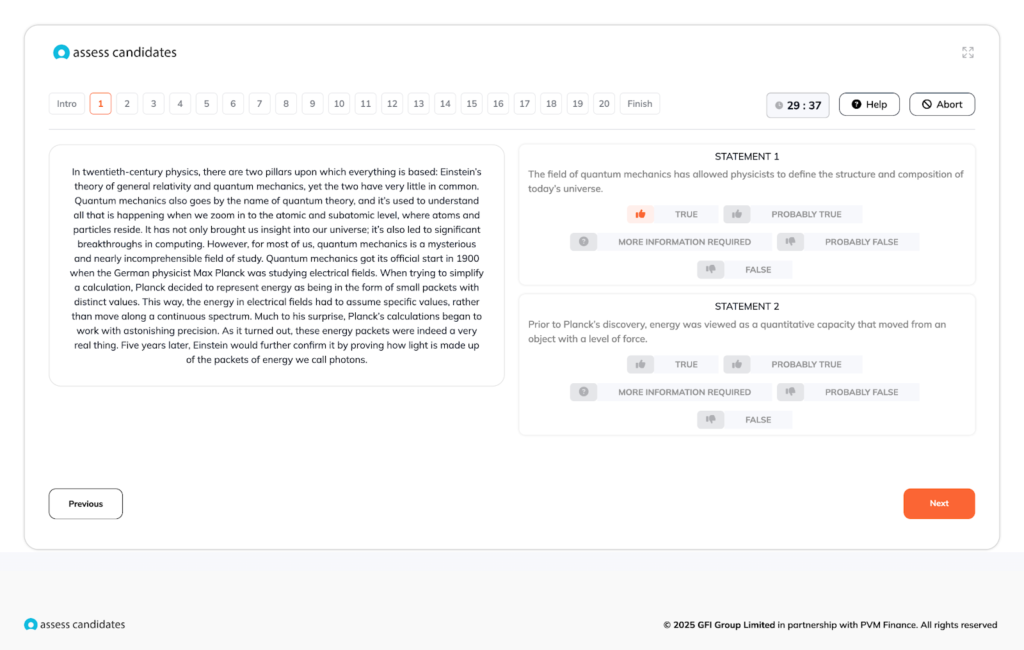
To get answers to all the questions mentioned in the images above, head down to the end of the article.
Discover our aptitude tests to identify top candidates with exceptional problem-solving and reasoning skills. LEARN MORE
In the following section, we will look into the importance of aptitude tests in the hiring process.
3. What is the importance of aptitude tests in hiring?
Aptitude tests are an essential part of modern recruitment, enabling employers to look beyond resumes and interviews to objectively evaluate candidates’ core skills and potential. They deliver reliable insights into problem-solving, reasoning, and learning ability, which are the key indicators of workplace performance and long-term success.

5 significant advantages of using aptitude tests during the recruitment:
1. Objective and Fair Assessment
Aptitude tests standardize evaluation by measuring every candidate against the same criteria. They minimize unconscious bias in interviews and highlight skills and potential over background, education, or connections.
2. Better Prediction of Job Performance
Aptitude tests directly measure problem-solving, reasoning, and analytical skills, making them stronger predictors of workplace performance than resumes or interviews that only showcase past achievements or soft skills.
3. Saving Time and Money
Recruitment demands significant resources, especially when recruiters must review large volumes of applications. Aptitude tests streamline the process by filtering out unsuitable candidates early, saving recruiters valuable time and cutting hiring costs.
By removing unfit applicants at the start, HR teams focus their efforts on candidates with the highest potential, boosting efficiency throughout the hiring cycle.
4. Improving Quality of Hire
Aptitude tests assess a wide range of cognitive skills, including numerical, verbal, logical, and abstract reasoning, to ensure that only candidates with the right capabilities move forward. They enable better hiring decisions by selecting candidates who not only meet basic requirements but also show adaptability and strong learning potential.
As a result, employees perform effectively from the start, need less training, and deliver greater long-term value to the organization.
5. Improving Workforce Diversity
Aptitude tests measure ability rather than relying solely on education or experience, giving candidates from diverse backgrounds an equal opportunity. This helps organizations build inclusive teams with broader perspectives.
While aptitude tests offer numerous advantages, it’s equally important to consider certain factors before using them in the selection process.
5 disadvantages of using aptitude tests for recruitment
- Test Anxiety: Many candidates feel stressed or anxious when completing aptitude tests, which can hinder their ability to demonstrate clear reasoning and problem-solving skills.
Solution: Combine game-based assessments with traditional aptitude tests or personality questionnaires. This creates a more engaging experience and reduces anxiety while still measuring critical abilities.
- Over-Reliance on Standardization: Aptitude tests often use standardized formats that may not reflect role-specific tasks or industry requirements.
Solution: Customize tests to align with real job challenges, or pair them with work sample tests for greater relevance.
- Cultural or Educational Bias: Some aptitude tests unintentionally favor candidates from particular cultural or educational backgrounds, putting others at a disadvantage.
Solution: Opt for culturally neutral, well-validated tests developed with diverse benchmark data to ensure fairness across different candidate groups.
- Accessibility Issues: Candidates with disabilities may face barriers in completing aptitude tests if the platform is not fully accessible.
Solution: Choose assessment providers that comply with accessibility standards (WCAG) and offer accommodations such as screen readers, larger text, or extended time where needed. Providers like Assess Candidates prioritize inclusivity by providing WCAG-compliant features.
- Cheating: In online settings, candidates may attempt to cheat by using external help or asking others to take the test for them, undermining the fairness of the process.
Solution: Choose providers with strong security measures such as remote proctoring, ID verification, randomized question banks, and cheat detection systems. Providers like Assess Candidates implement these safeguards to maintain test integrity.
Boost your recruitment process by including cognitive ability tests to identify top candidates faster. HIRE FOR FREE
Next up, we will explore the stages of the hiring process where aptitude tests are applied.
4. At what stage are aptitude tests used in the hiring process?
Employers can strategically use aptitude tests at different stages of the recruitment process, depending on the role’s nature and seniority. These tests add the most value during early screening and candidate filtering, where they quickly identify individuals with strong cognitive abilities.
By applying aptitude tests at this stage, employers efficiently spot top-performing candidates while saving time and resources. For stronger results, combine aptitude tests with other assessments, such as personality tests and game-based assessments, to build a more complete picture of each candidate’s potential.
Below is a detailed explanation of the various hiring stages in which aptitude tests are used:

Let’s now look into how aptitude tests work as recruitment tests in job interviews.
5. How do aptitude tests work as hiring tests in job interviews?
If employers skip aptitude tests during the initial screening, it becomes crucial to evaluate candidates’ cognitive skills during interviews, whether in-person or via video.
Including structured aptitude-based questions covering numerical, verbal, logical, abstract, or diagrammatic reasoning can help evaluate problem-solving, critical thinking, comprehension, and decision-making abilities. This further provides a more accurate measure of a candidate’s potential and reduces the risk of mis-hires or skill gaps.
What are the aptitude questions commonly used in job interviews?
Aptitude questions are widely used in job interviews to evaluate a candidate’s core cognitive abilities and problem-solving skills. These questions help employers gauge how well candidates can reason, analyze information, and apply their knowledge in practical scenarios relevant to the role.
- Numerical Reasoning Test
Numerical reasoning tests evaluate a wide range of skills, from basic arithmetic and percentages to complex problem-solving. They include graph-based questions, estimations, and multi-step numerical exercises.
Example: “A store sold 120 units of a product in January and 150 units in February. What was the percentage increase in sales from January to February?”
- Verbal Reasoning Test
Verbal reasoning test questions assess a candidate’s ability to understand and analyze written information. They include true/false/cannot say questions, vocabulary, grammar, word analogies, and reading comprehension tasks.
Example:
Passage: “All employees at the company receive annual training. Some employees also participate in monthly workshops.”
Statement: “All employees at the company participate in monthly workshops.”
- Logical Reasoning Test
Logic test questions assess a candidate’s reasoning and analytical skills by having them recognize patterns, solve hypothetical or real-world problems, draw conclusions from statements, and identify broader trends.
Example: “What comes next in the sequence: 2, 4, 8, 16,?”
- Abstract Reasoning Test
Abstract reasoning tests evaluate a candidate’s ability to recognize patterns, relationships, and rules in visual or conceptual information. They commonly include sequence, matrix, odd-one-out, and analogical comparison questions.
Example:
“Next in the Sequence:
A sequence of shapes is shown: ■, ▲, ■, ▲, ■, ?”
- Diagrammatic Reasoning Test
The diagrammatic reasoning test assesses a candidate’s ability to interpret and analyze visual information using logical rules. Common types include sequence diagrams, flowcharts, and diagram completion tasks.
Example: “Which diagram below matched the missing part of the sequence?”
- Spatial Reasoning Test
Spatial reasoning tests evaluate a candidate’s ability to visualize, manipulate, and navigate objects or spaces. Common question types include 2D to 3D transformations, rotations, reflections, block counting, and map reading.
Example.8: A shape is shown, and the candidate is asked to select “Which option represents the shape after a 90-degree clockwise rotation?”
- Situational Judgment Test
Situational judgment tests measure a candidate’s behavioral competencies and decision-making in workplace scenarios. Common question types include conflict resolution, customer service, decision-making, and teamwork.
Example: “You notice two team members are constantly disagreeing, which is affecting team morale and productivity. How would you handle this situation?
Options:
- Ignore the conflict and focus only on your own tasks.
- Bring both members together to discuss openly and find common ground.
- Immediately report the issue to your manager without attempting to address it yourself.
- Speak to each member individually, then mediate a joint resolution.”
- Critical Reasoning Test
Critical reasoning tests measure a candidate’s ability to analyze information, think logically, and make sound judgments. They include questions on inference, assumptions, deductions, interpretations, argument evaluation, and strengthening or weakening conclusions.
Example:
Passage: “All employees complete mandatory safety training. Some employees also attend optional skill workshops.”
Question: Evaluate the statement: “All employees attend optional skill workshops.”
Strengthen your hiring strategy by incorporating psychometric tests. LEARN MORE
To get answers to all the questions mentioned above, head down to the end of the article.
In the following section, we will explore the best practices for including aptitude tests in your pre-employment process.
6. What are the best practices for including aptitude reasoning tests in your selection process?
To get the best results from an aptitude test in your hiring process, follow these key best practices.
Below are three simple steps to help you efficiently shortlist and select the right candidates from the start.
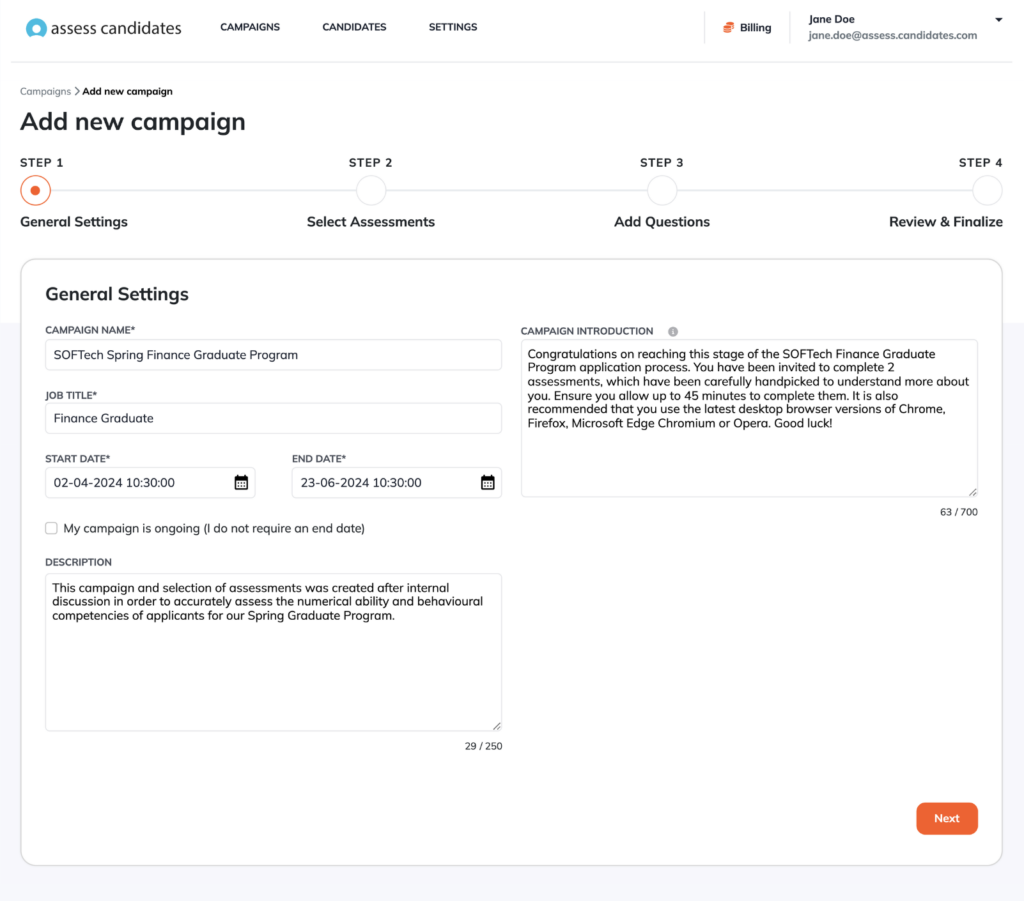
Create Your Aptitude Assessment Campaign
- Choose the mix of aptitude test sections most relevant to the role, such as numerical, verbal, logical, spatial, or situational judgment. Align the assessment with job requirements by defining time limits and deadlines to ensure fairness for all candidates.
- Set clear cut-off scores for your aptitude test before launching your recruitment campaign, based on industry standards, role requirements, and the level of logical reasoning skills needed.
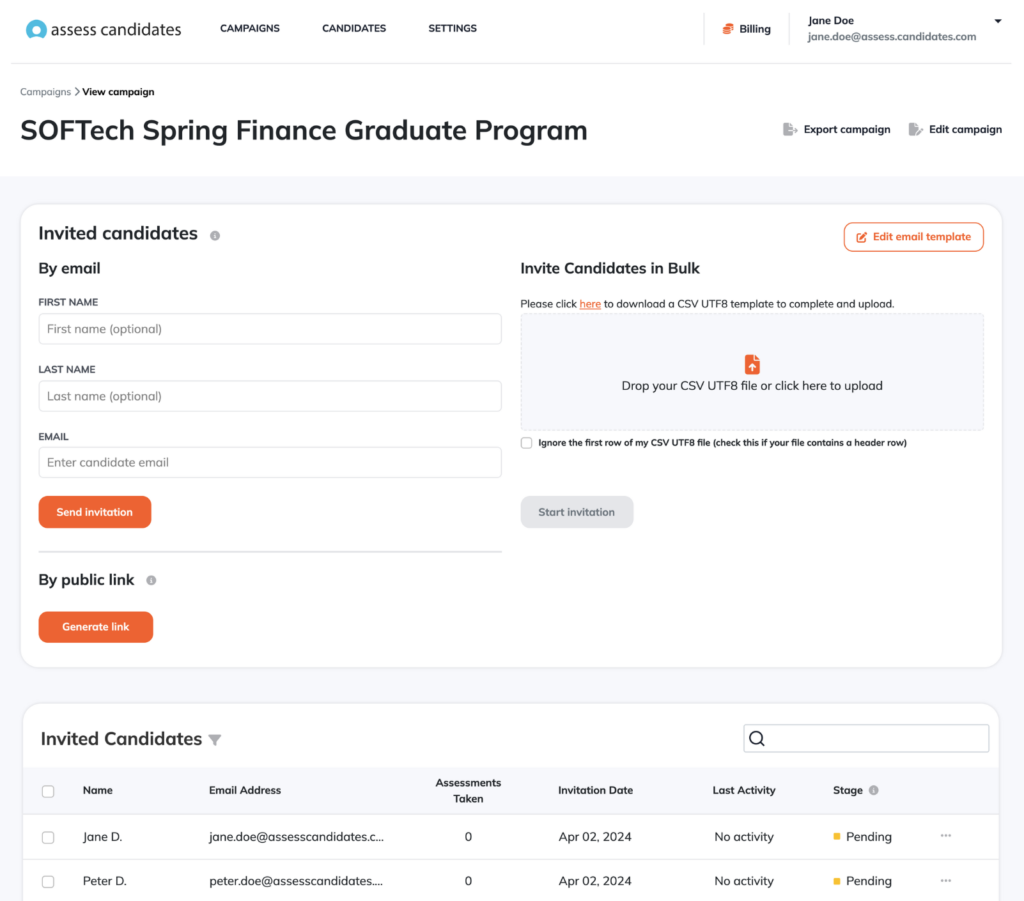
Invite Candidates to Your Aptitude Assessment
- Send assessment invitations through email, bulk upload (CSV), or a public link.
- Share clear instructions and provide seamless access so candidates can complete the test without difficulty.
Analyze Candidate Results and Shortlist Top Talent
- Monitor progress in real time as candidates complete different aptitude sections.
- Access instant, automatically graded reports that provide both overall aptitude scores and section-level insights.
- Use ranking, filtering, and comparison tools to efficiently shortlist top candidates for the next stage.
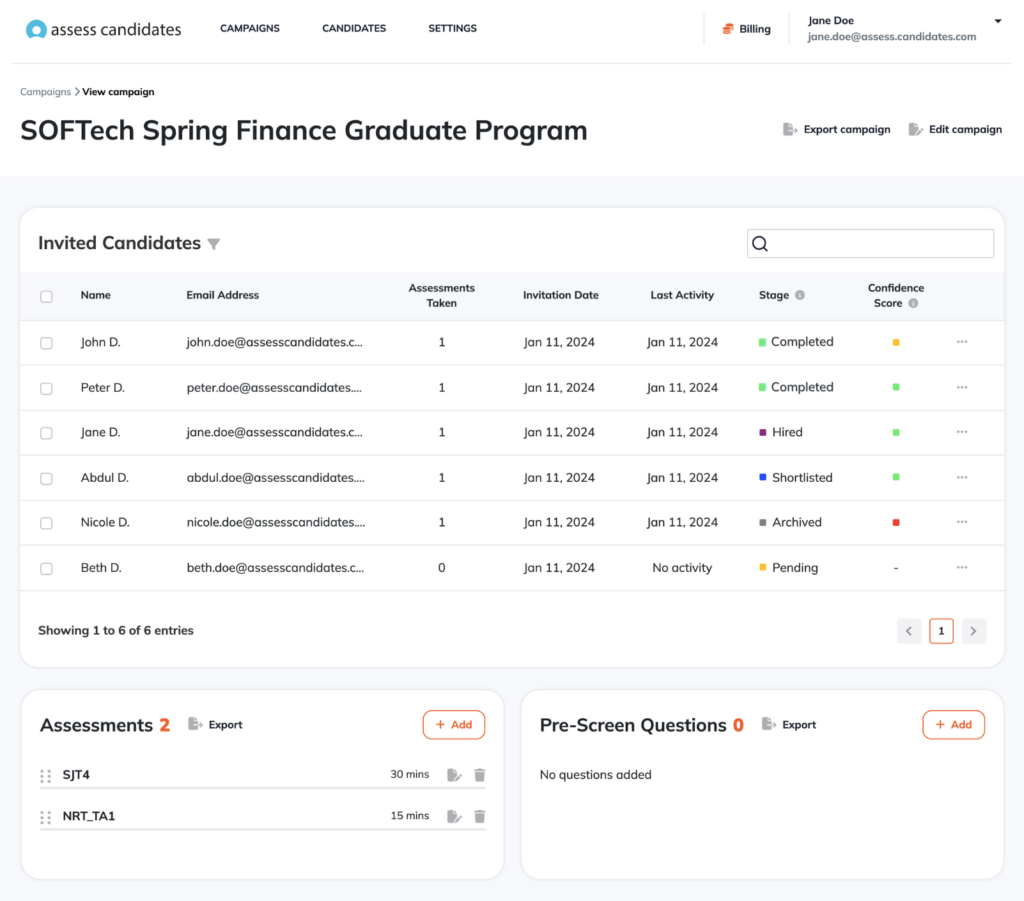
By following this structured, efficient process, employers can make informed, data-driven hiring decisions and identify candidates with the aptitude skills required for success across multiple roles
Next up, we will take a look at the key industries and roles that should use aptitude tests for recruitment.
7. Which industries and roles should use aptitude tests for recruitment?
Different industries and roles require distinct competencies, and aptitude tests allow organizations to identify candidates who are most likely to succeed. By providing a fair, standardized, and efficient evaluation method, aptitude tests help businesses make informed hiring decisions and build a high-performing workforce.
Industries that use aptitude tests for recruitment
The following are the top 5 industries that use cognitive ability tests for hiring:
- Finance and Banking
Banks and financial institutions evaluate candidates’ numerical reasoning, analytical thinking, and decision-making skills through aptitude tests to ensure accurate handling of financial data and reduce risks.
Major employers like HSBC, Goldman Sachs, and Morgan Stanley use aptitude tests extensively in employment.
- Technology and IT
Tech companies measure logical reasoning, abstract thinking, and numerical ability with aptitude tests to identify candidates who can solve coding challenges, analyze data, and design systems effectively.
Leading employers like Google, Microsoft, and Infosys rely on pre-employment cognitive ability tests for graduate and lateral hiring.
- Consulting
Consulting firms assess data interpretation, problem–solving, and structured reasoning through aptitude tests to select candidates who can deliver actionable solutions to client problems.
Top consulting firms, including Deloitte, KPMG, and McKinsey & Company, make aptitude testing central to recruitment.
- Engineering and Manufacturing
Engineering firms apply aptitude tests to assess spatial reasoning, mechanical comprehension, and problem-solving, selecting candidates who can apply technical knowledge in real-world scenarios.
Siemens, Rolls–Royce, and General Electric rely on cognitive ability tests for recruitment.
- Retail and FMCG
Retail and FMCG companies use aptitude tests to measure numerical reasoning and decision-making under pressure, identifying candidates who can manage inventory, analyze sales data, and interpret customer insights.
Leading companies like Unilever, Procter & Gamble (P&G), and Walmart include aptitude tests in the hiring process.
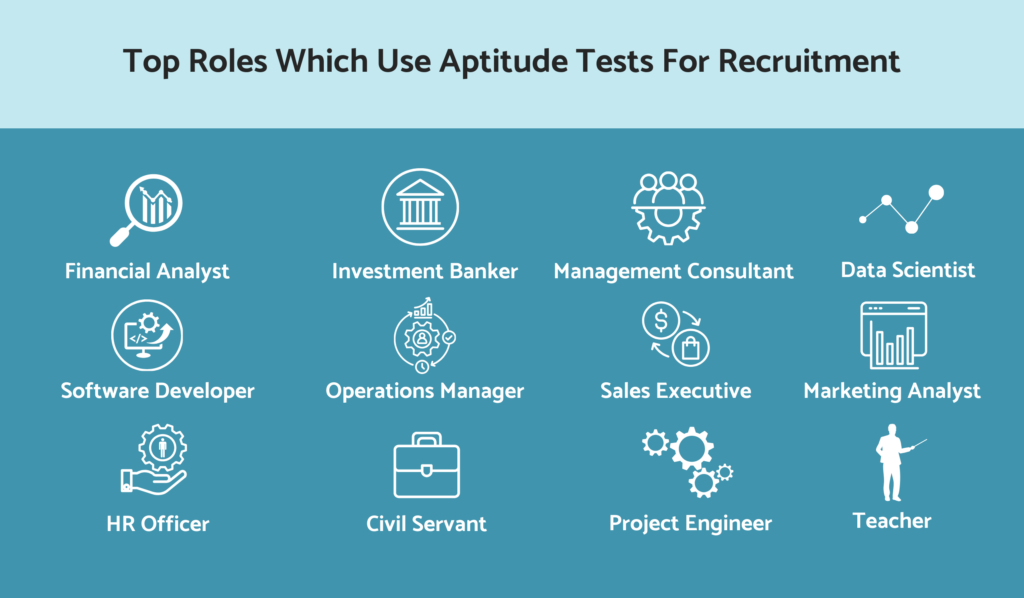
Roles that use aptitude tests for recruitment
- Financial Analyst
- Investment Banker
- Management Consultant
- Data Scientist
- Software Developer
- Operations Manager
- Sales Executive
- Marketing Analyst
- Human Resources Specialist
- Civil Servant
- Project Engineer
- Teacher/Lecturer
In the following section, we will explore the employers that utilize aptitude tests in their pre-employment recruitment process.
8. Which employers use aptitude tests for recruitment?
Employers across industries frequently use aptitude tests to evaluate candidates’ cognitive abilities, problem-solving skills, and learning potential. By objectively measuring numerical, verbal, logical, and abstract reasoning, these tests help organizations identify the most suitable candidates, make informed, data-driven hiring decisions, and build a capable, high-performing workforce.
Here are some well-known companies that use aptitude tests in their recruitment process:
- Amazon
- Goldman Sachs
- Deloitte
- Unilever
- PwC
- HP
- Accenture
- KPMG
- Lloyds Banking Group
- EY
- Siemens
- JP Morgan
Explore our talent assessment platform to discover top talent and join us. LEARN MORE
9. Aptitude Tests: Client Application Story
Client Problem Statement
Imagine a rapidly expanding technology firm is struggling to hire skilled professionals for analytical and technical roles. Although the company receives numerous applications, its current recruitment process does not effectively assess candidates’ overall aptitude, including logical reasoning, numerical ability, and problem-solving skills.
This gap results in inconsistent hiring decisions, extended project ramp-up times, and added pressure on HR and technical teams. The company needs a reliable method to evaluate candidates’ core cognitive abilities to ensure success in critical roles.
Assess Candidates Proposal
At Assess Candidates, we recommend introducing a comprehensive aptitude test at the initial stage of recruitment. This test measures candidates’ numerical reasoning, verbal reasoning, logical reasoning, and problem-solving skills. By evaluating these abilities early, recruiters can quickly filter applicants and focus on those with the strongest cognitive capabilities, ensuring they are well-suited for analytical, technical, and decision-making responsibilities.
Recruiters are primarily responsible for administering the aptitude test and deciding the appropriate benchmark score or cut-off range required for candidates to move forward. For instance, a company might set the aptitude test passing score at the 70th percentile, meaning only candidates who perform better than 70% of the norm group are considered for subsequent rounds.
Cut-off ranges for aptitude tests typically fall between the 50th percentile (for large applicant pools) and the 70th–80th percentile (to select only top-performing candidates).
Result
Implementing aptitude tests will allow the company to identify high-performing candidates with the cognitive skills needed for success. This structured approach will improve hiring quality, reduce onboarding time, and strengthen team productivity.
Ultimately, the organization will build a more capable workforce, driving efficiency, innovation, and long-term growth.
Partner with Assess Candidates to include scientifically validated psychometric tests in your hiring process. VIEW PLANS
So, why choose us?
10. Why top companies choose Assess Candidates’ aptitude tests for recruitment
At Assess Candidates, we offer a comprehensive suite of pre-employment aptitude tests, including numerical, verbal, and logical reasoning, and create recruitment campaigns tailored to each organization’s unique hiring needs.
Here is an example of our campaign reporting dashboard available on Assess Candidates.
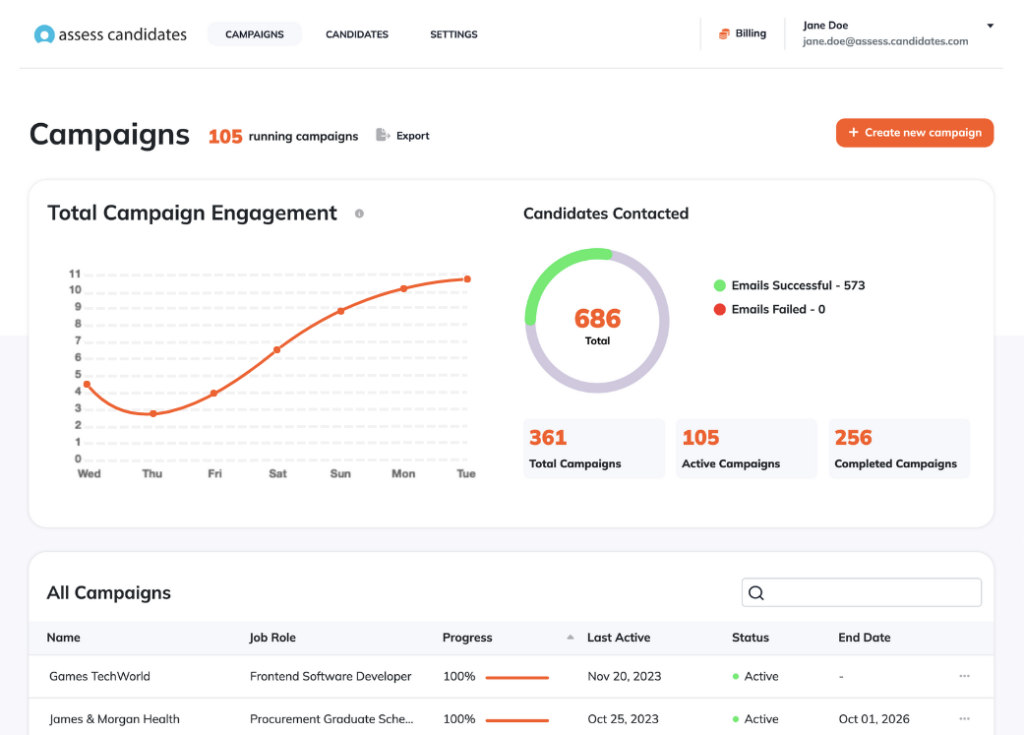
Here are the top 4 reasons why you should use Assess Candidates’ aptitude assessments for your pre-employment selection process:
- Scientifically Designed and Validated by Expert Psychologists: Assess Candidates’ aptitude tests are developed by Chartered Scientists, Psychologists, and Psychometricians with decades of experience creating assessments for top organizations like SHL and IBM Kenexa. Each test is meticulously validated to accurately measure candidates’ cognitive abilities, ensuring companies can identify and hire high-performing talent across roles and industries.
- Expert Reporting: Our intuitive platform allows employers to analyze candidate performance and make data-driven hiring decisions quickly. Recruiters can review individual results, filter, rank, and shortlist candidates efficiently. The talent assessment platform also integrates seamlessly with your ATS, simplifying your recruitment workflow.
- Positive Candidate Experience: Our aptitude tests work on any device and feature a clear, user-friendly interface. Candidates receive straightforward instructions, navigate with minimal clicks, and progress automatically through questions. Tests can also be branded to reflect your organization, enhancing the candidate experience and employer brand.
- Candidate Accessibility Support: We prioritize inclusivity by offering extra time options, zoom functionality, accessible color schemes, and screen reader compatibility, all fully compliant with WCAG standards. This ensures candidates with disabilities or visual impairments can participate fairly.
Assess Candidates provides reliable, end-to-end pre-employment assessment solutions for employers of all sizes. Explore our aptitude tests today and start hiring the best-fit candidates with confidence.
Not sure if aptitude tests suit your recruitment process? Contact us for a free analysis of your hiring needs.
Answers to the above example questions
- Assess Candidates Numerical Reasoning Test Example Question: €21.22m
- Assess Candidates Verbal Reasoning Test Example Question: True
- Assess Candidates Logical Reasoning Test Example Question: Option A
- Assess Candidates Abstract Reasoning Test Example Question: Option A
- Assess Candidates Diagrammatic Reasoning Test Example Question: Option B
- Assess Candidates Spatial Reasoning Test Example Question: 27
- Assess Candidates Situational Judgment Test Example Question:
- Best option: B
- Worst option: C
- Assess Candidates Critical Reasoning Test Example Question:
- Statement 1: Probably True
- Statement 2: False
- Numerical Reasoning Test: 25%
- Logical Reasoning Test: 32
- Verbal Reasoning Test: False
- Abstract Reasoning Test: ▲
- Situational Judgment Test:
- Best option: D
- Worst option: A
- Critical Reasoning Test: False
Interested in learning more about effective candidate assessment? Continue reading for frequently asked questions, and sign up with your email to get started.
Frequently Asked Questions
Why should aptitude tests be used for recruitment?
Aptitude tests allow employers to objectively evaluate candidates’ cognitive abilities, including numerical, verbal, logical, and abstract reasoning skills. They standardize assessments, eliminate bias, and highlight problem-solving, learning potential, and decision-making, helping employers shortlist candidates who fit the role and contribute effectively from day one.
Should aptitude tests replace interviews?
No. Employers should use aptitude tests to complement, not replace, interviews. While tests evaluate cognitive abilities objectively, interviews assess soft skills, cultural fit, and role-specific competencies. Combining both methods provides a balanced, data-driven evaluation and captures a complete picture of each candidate’s suitability.
How to interpret aptitude test results?
Employers interpret aptitude test results using detailed scoring metrics, including overall performance, percentile ranks, and skill-specific insights. They set an aptitude test pass mark as a clear cut-off to identify candidates meeting minimum requirements. Comparing results and top performers ensures consistent, role-aligned, and data-driven hiring decisions.
What is the recommended pass mark for an aptitude test?
At Assess Candidates, we recommend setting the aptitude test pass mark around the 30th percentile. This lower cut-off ensures you don’t overemphasize a single assessment, allowing you to efficiently filter candidates while maintaining a balanced and fair hiring process that considers multiple evaluation methods.
Are aptitude tests suitable for all roles and industries?
Yes. Aptitude tests can be used across a wide range of industries and roles, from finance, consulting, and IT to healthcare, manufacturing, and retail. They customize tests to focus on relevant cognitive abilities, ensuring that candidates demonstrate the skills needed to succeed at both entry-level and senior positions.


 English
  Arabic