
Gen Z in the Workforce: Why Hiring Them Matters in 2026



Gen Z is increasingly entering the workforce, seeking internships, entry-level job positions, and long-term career growth opportunities.
According to Deloitte, Gen Z is on track to become the largest generation in the global workforce, already making up approximately one-third (30%) of employees worldwide. This is why many companies are rethinking their hiring strategies to attract and recruit more Gen Z talent, effectively assessing their skills through modern methods such as psychometric tests and AI-powered video interview platforms.
These assessment tests for Gen Z help employers identify their key strengths, including tech-savviness, adaptability, problem-solving skills, and innovative thinking. Understanding and leveraging these unique qualities is essential for building future-ready teams.
By tailoring assessments to highlight these specific strengths, employers can make more informed hiring decisions while also creating roles and environments that foster Gen Z workers’ growth and development. This approach sets the stage for employers tapping into the full potential of this dynamic generation and ensuring better job-role fit, lower turnover, and higher productivity.
If you want answers to questions like these:
- How is Gen Z recruitment different from millennials and baby boomers?
- What are the best psychometric tools to test Gen Z candidates?
- Are situational judgment tests suitable for assessing Gen Z?
- How are leading companies successfully integrating Gen Z into
This is the right guide for you!
This article is designed for recruiters, hiring managers, and talent acquisition leaders seeking to attract, engage, and recruit Gen Z employees. Discover actionable insights, practical benefits, and proven methods to evaluate candidates effectively and ensure they thrive within your team and organizational culture.
Let’s begin this article by defining who Gen Z is and exploring their impact on today’s workforce and industries.
Contents
- Who is Gen Z?
- What are the key strengths of Gen Z in the workplace?
- How do Gen Z employees work differently than millennials?
- What are the top benefits of recruiting Gen Z in the workforce?
- What are the best strategies to attract and retain Gen Z talent?
- Which pre-employment assessments and tools help hire Gen Z?
- What obstacles do employers face when recruiting Gen Z?
- In which roles and sectors do Gen Z workers excel?
- Leading employers successfully recruiting Gen Z in the workforce
- Why do companies choose Assess Candidates for their Gen Z assessment process?
- What will Gen Z recruitment look like in the future?
Without delaying any further, let’s get into it!
1. Who is Gen Z?
Generation Z (Gen Z) refers to the cohort of individuals born between 1997 and 2012, following millennials (1981-1996). Often categorized as the digital-savvy generation, Gen Z grew up during the rapid evolution of technology and social media. This shapes their communication styles, work preferences, and the values they look for in employers.
In 2025/26, Gen Z is becoming a major force in the workforce, prompting employers to adapt traditional recruitment strategies to attract and engage this generation. Their digital fluency makes virtual hiring methods, like video interviews, gamified testing, and online assessments, effective.
However, the challenge in Gen Z recruitment is balancing technical ability with cultural fit. Gen Z values flexibility, work-life balance, transparency, and authenticity in their careers and they want to work for companies who demonstrate social responsibility and clear missions.
This means assessment processes must evaluate both skills and cultural alignment to ensure long-term success. Gen Z is already reshaping the workplace, presenting both challenges and opportunities for businesses to refine modern hiring methods, foster inclusivity, and drive innovation.
What is the percentage of Gen Z in the workforce? According to McKinsey, Gen Z makes up roughly 27% of the global workforce – and is continuing to grow.
Looking to hire Gen Z? Use our modern pre-employment tests to find best-fit candidates for your role. HIRE FOR FREE
Having explained who Gen Z is, now let’s explore what the key characteristics and strengths of Gen Z employees are.

2. What are the Key Strengths of Gen Z in the Workplace?
Gen Z is characterized by distinctive characteristics that have been shaped by rapid technological growth, social change, and global connectivity. Contrary to the stereotypical perception that this generation is “lazy” or “unmotivated” in the workplace, Gen Z has proven to be the most entrepreneurial and innovative compared to millennials and baby boomers.
Global research highlights that 69% of Gen Z are optimistic about entrepreneurial accomplishments, whether for themselves or within organizations. This outlook, combined with their digital fluency and openness to change, makes them valuable employees across industries.
Gen Z has several key strengths, but the most defining are their strong technological proficiency, adaptability and resilience, and their commitment to diversity and inclusion.
Here are the top 9 strengths of Gen Z in the workplace:

1. Financially Cautious
Gen Z is money-conscious, shaped by growing up during economic instability and witnessing events like constant inflation, recession, and unstable job markets. They are comfortable with digital banking, mobile payments, and cryptocurrencies, often exploring early investing and alternative paths to financial independence and wealth-building.
2. Mental Health Awareness
Gen Z is leading the way in destigmatizing mental health, openly seeking therapy, counseling, and support for emotional well-being more than previous generations. Despite this growing awareness, they experience high levels of stress and anxiety, often driven by academic pressures, constant social media comparisons, and concerns about an uncertain future, including financial instability.
3. Socially Conscious
Gen Z is known to be politically and socially conscious, frequently advocating for issues such as climate change, racial justice, income inequality, and human rights through online activism and public protests. This generation also prioritizes sustainability, showing strong preference for eco-friendly products, ethical brands, and sustainable lifestyle choices that align with their values.
4. Collaborative Spirit
Although valuing individuality, Gen Z also works well in teams, especially in collaborative, creative environments. They prefer workplaces that encourage idea-sharing, constructive feedback, and inclusive participation.
5. Entrepreneurial Mindset
Gen Z is highly entrepreneurial, often engaging in side hustles or launching their own businesses at a young age. The gig economy and a desire for financial independence fuel this trend, while the rise of social media has made becoming content creators or influencers popular and attainable careers, blending creativity with income potential.
6. E-Learning and Career-Oriented
Gen Z embraces self-education through online platforms like YouTube, Coursera, and Udemy, often turning to non-traditional sources to gain skills and knowledge. They value flexible, remote-friendly careers that align with their personal values, seeking both autonomy and meaningful impact.
7. Dynamic Work Preferences
Gen Z prefers dynamic, flexible work environments that support healthy work-life balance and personal growth. They are more open to job hopping, frequently seeking new challenges and fulfillment rather than staying in one role or for one employer long term.
8. Digital-Savvy and Adoption of Artificial Intelligence (AI)
As true digital natives, Gen Z is highly adaptable and tech-savvy, seamlessly switching between devices, apps, and tasks like social media, studies, and work. They are quick to adopt emerging technologies, with 37% using ChatGPT in the past month, viewing AI as a valuable support for creativity, research, and problem-solving. At the same time, they expect companies to be transparent about how AI is used and the benefits it provides.
9. Diversity, Equity, and Inclusion
In the US, about 30% of Gen Z consider diversity, equity, and inclusion (DEI) vital in every aspect of life, including work, lifestyle, and entertainment. They are not only culturally and ethnically diverse, but they also have a higher acceptance rate of the LGBTQIA+ community and a strong sense of global citizenship due to internet connectivity and exposure to diverse cultures.
Use our science-backed, reliable psychometric tests to assess your Gen Z applicants’ key skills. LEARN MORE
Having discussed the strengths of Gen Z, let’s look at how Gen Z differs from millennials at work.
3. How Do Gen Z Employees Work Differently Than Millennials?
While Gen Z and millennials share digital fluency, they bring different perspectives, work habits, and expectations to the workplace. Understanding these differences helps organizations adapt to a diverse, multi-generational workforce and tailor recruitment, communication, and Gen Z retention strategies.
Unlike millennials, who entered the workforce during relative economic growth, the experiences of Gen Z during economic instability, rapid technological change, and heightened social awareness have shaped their workplace values. They differ by prioritizing mental health support, flexibility, purpose, and work-life balance.
Gen Z workers also prefer real-time communication tools like Slack over formal emails, expecting transparency around social values and technology use, and workplaces that embrace continuous learning and authenticity.
Gen Z vs. Millennials in the Workplace
Up next: the top 6 advantages of recruiting Gen Z talent and how they can add unique value to your business.
4. What are the Top Benefits of Recruiting Gen Z in the Workforce?
As Gen Z becomes more dominant in the workforce, their values and skills are proving to be a major asset for employers. This generation offers unique advantages that can strengthen teams and future-proof businesses in evolving areas such as sustainability, ethics, and flexible working.
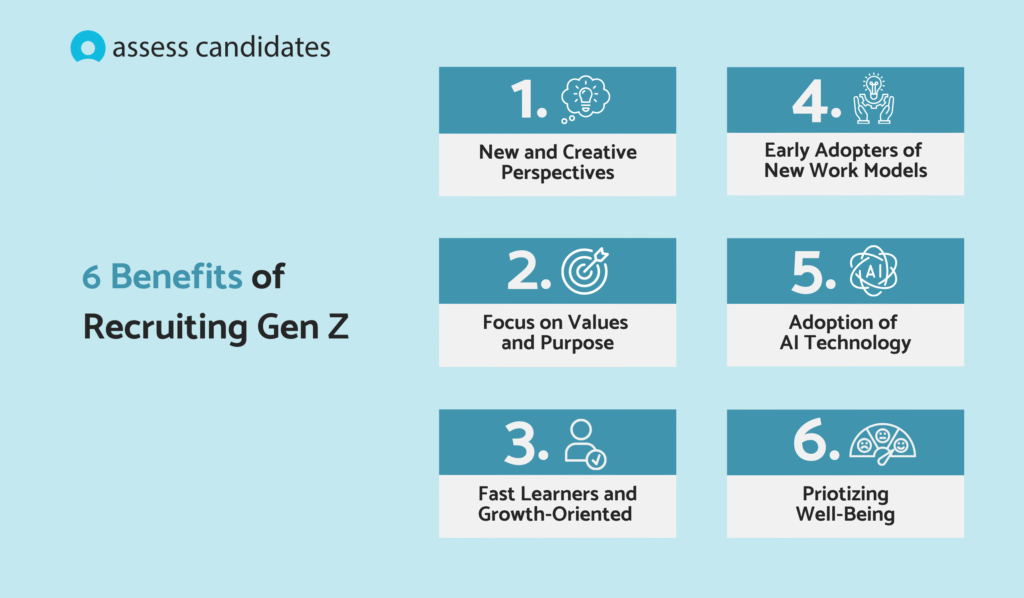
6 benefits of recruiting Gen Z talent in your company
1. New and Creative Perspectives
Gen Z brings creative and innovative approaches to problem-solving, design, and product development. Their exposure to diverse online communities makes them especially attuned to current cultural trends, which help companies remain relevant in evolving markets.
According to McKinsey, companies with greater generational diversity outperform peers in innovation metrics.
2. Focus on Values and Purpose
Gen Z places a high priority on ethics, sustainability, and inclusivity. When aligned with an employer’s mission, they become deeply engaged contributors and loyal ambassadors. They also help hold companies accountable in their social impact goals.
Deloitte Global Gen Z Survey reveals that 73% of Gen Z say they would not work for a company that doesn’t reflect their values.
3. Fast Learners and Growth-Oriented
Gen Z values development and continuous learning. They actively seek feedback, mentorship, and opportunities to upskill, making them a strong fit for organizations that prioritize internal mobility and employee growth.
PwC Future of Work Report states that 61% of Gen Z workers say career growth opportunities are a top priority in choosing a job.
4. Early Adopters of New Work Models
Gen Z is comfortable with hybrid, remote, freelance, and gig work. Their flexibility and adaptability helps organizations test new work structures and respond to rapidly shifting workforce trends.
Forbes reports that Gen Z is the most open generation to non-traditional career paths and side gigs.
5. Adoption of AI Technology
Gen Z’s strong familiarity with emerging technologies, like ChatGPT, makes them valuable assets for companies ethically integrating AI and digital tools. Hiring Gen Z helps organizations build a tech-forward workforce ready to embrace innovation.
Pew Research Centre claims that 43% of those under 30 are active users of AI.
6. Prioritizing Well-Being
Gen Z places a high value on health, well-being, and personal balance as essential to both career success and overall happiness. They expect employers to help reduce burnout, support mental health, and promote sustainable performance. By recruiting Gen Z in the workforce, organizations can cultivate a culture of work-life balance, resilience, and long-term employee engagement.
According to the Top Employers Institute, 82% of Gen Z value and prioritize their well-being.
Enhance your Gen Z hiring with our accessible, user-friendly, bias-free assessment platform. LEARN MORE
When recruiting Gen Z talent, understanding the best strategies for attracting, hiring, and retaining them is crucial. Keep reading to find out how!
5. What are the Best Strategies to Attract and Retain Gen Z Talent?
Attracting, hiring, and retaining Gen Z requires a fresh approach that aligns with their values, priorities, and expectations. This generation seeks more than just a paycheck; they expect employers to demonstrate authenticity, forward-thinking values, and a commitment to employee experience at every stage of the journey.
To stand out and engage Gen Z talent, employers must adapt their recruitment strategies to be personalized, transparent, and aligned with Gen Z’s expectations of modern work, offering more meaningful development paths and inclusive ideals.
Key strategies that to help successfully attract, hire and retain Gen Z in the workforce

- Offer Flexibility and Work-Life Balance: Gen Z places a high value on flexibility in how and when they work. Offering remote or hybrid work options appeals to their desire for autonomy and work-life balance. Additionally, flexible hours that allow them to manage their schedules can significantly boost job satisfaction and increase retention.
- Support Mental Health and Well-Being: Provide access to mental health resources and wellness programs, and foster an open, supportive culture where mental health is openly discussed and prioritized.
- Build an Inclusive and Transparent Culture: Gen Z seeks diverse, equitable workplaces where inclusion is a core value. Prioritize inclusive hiring, transparent communication, and collaborative team dynamics to create an environment where they feel valued, informed, and empowered to contribute.
- Embrace Technology and Innovation: Gen Z expects a modern, tech-driven workplace. Equip teams with up-to-date tools and digital collaboration platforms to boost efficiency, support remote work, and create a seamless, connected work experience.
- Support Growth and Development: Gen Z values continuous learning and clear career progression. Offer opportunities like online courses, mentorship, and leadership training, while outlining clear career paths to keep them engaged, motivated, and invested in their future with your company.
- Provide Competitive Compensation and Benefits: To attract Gen Z talent, offer competitive pay along with meaningful perks such as student loan assistance, financial wellness tools, and comprehensive benefits. Innovative offerings like pet insurance, gym memberships, or childcare support can further set your company apart.
- Create an Engaging Workplace Experience: Make work enjoyable by incorporating gamified elements like challenges and rewards, and design visually appealing, modern spaces that promote creativity, recognition, collaboration, and a sense of belonging for Gen Z.
Gen Z recruitment strategies made easy for you to build successful, cohesive teams. HIRE FOR FREE
How is recruiting Gen Z different from hiring millennials and baby boomers?
Recruiting Gen Z differs from hiring millennials and baby boomers because of their unique values, expectations, and familiarity with tech. Gen Z seeks transparency, flexibility, diversity, and inclusion, and purpose-driven work, unlike baby boomers who value stability and loyalty, or millennials who prioritize career growth and in-person collaboration.
Gen Z candidates are tech-savvy and during recruitment expect fast-paced environments, real-time feedback, remote or hybrid options, a strong company culture, and communication through modern tools like video interview platforms. They are also more comfortable with AI, automation, and digital pre-employment assessments.
For employers, this means traditional hiring tactics, like lengthy in-person interviews or hierarchical career ladders preferred by baby boomers, won’t resonate. Instead, leveraging technology, emphasizing inclusion, and creating flexible pathways for growth are key to engaging and retaining Gen Z workers.
Now, this leads us nicely to our next section exploring in detail which pre-employment assessments and modern hiring tools help when recruiting Gen Z talent.
6. Which Pre-Employment Assessments and Tools Help Hire Gen Z?
When faced with hiring Gen Z candidates into your company, you may be conflicted on what route to take. Gen Z recruitment requires more than standard CV screening or interviews. As digital natives, they respond best to modern, data-driven assessments that evaluate both technical skills and cultural fit.
The right tools not only predict job performance and potential but also create a hiring experience that is transparent, fair, and engaging for this generation.
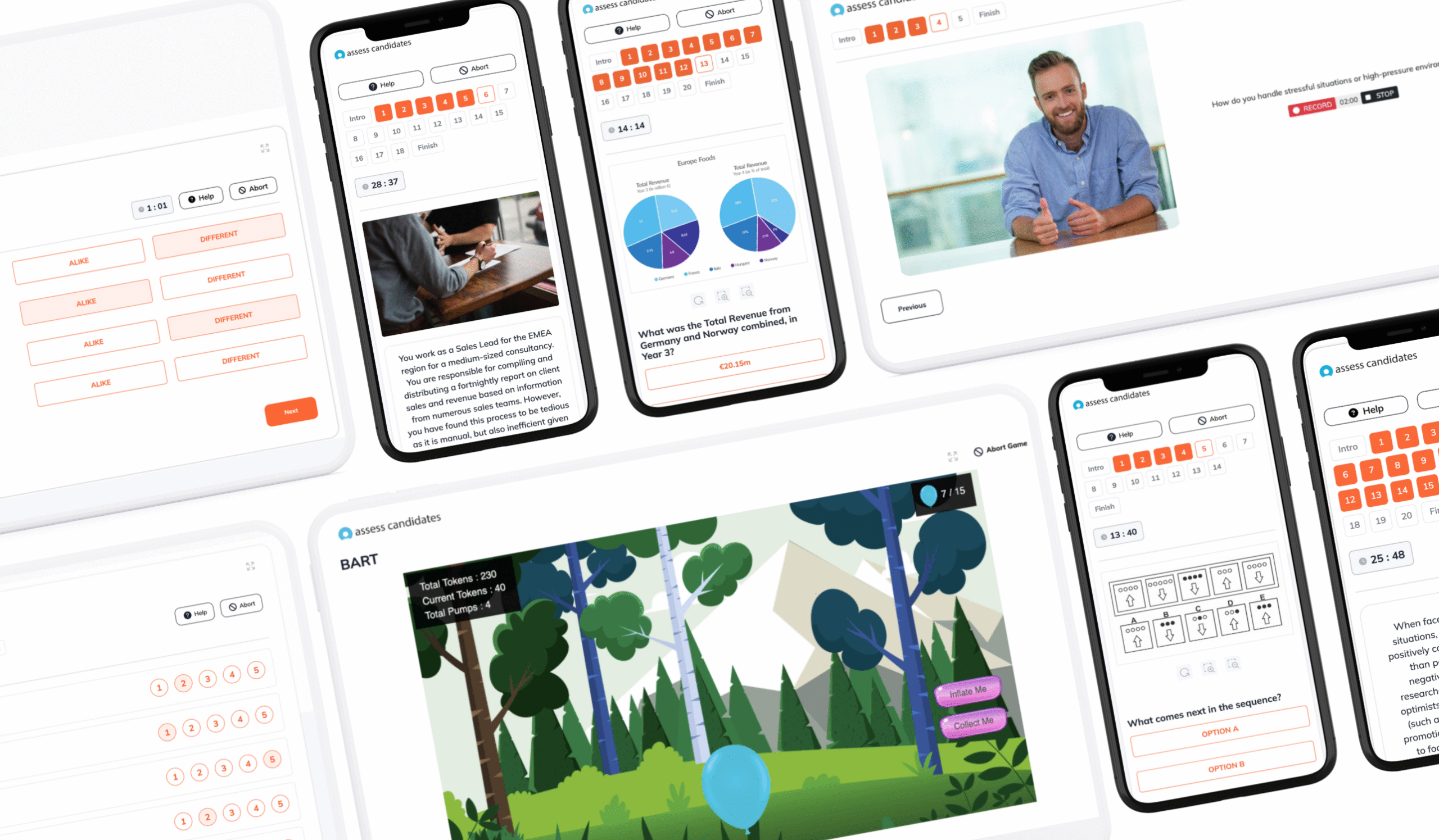
Here are the top candidate assessment tools and pre-employment tests to hire Gen Z into your workforce:
1. Psychometric Assessment Tests
Employers often use online psychometric testing to assess Gen Z candidates’ skills and alignment to the role and company before employment. These are the following:
Numerical tests evaluate Gen Z’s numerical reasoning ability, mathematical skills, speed, and accuracy. In these assessments, Gen Z applicants are tested on their knowledge of ratios, percentages, fractions, etc, and their ability to interpret charts, graphs, and tables.
Verbal tests ask candidates to answer multiple-choice questions designed to assess the literacy, vocabulary, reading skills, and verbal comprehension of Gen Z applying to fields that require strong written and verbal communication.
Logical reasoning tests require Gen Z candidates to identify the correct patterns in sequences of diagrams and shapes to predict the next image. These assessments evaluate logical thinking skills and the ability to deduce and solve problems by reaching logical conclusions..
Critical reasoning tests include critical verbal and numerical reasoning ability questions. This psychometric test assesses Gen Z’s ability to decode and interpret important information, along with the capability to think critically.
Situational judgment tests are scenario-based asking candidates to select the most and least appropriate solutions to realistic workplace challenges. You can tailor these assessments to specifically evaluate Gen Z’s strengths, including their communication and collaboration skills, ability to plan, organize, and persuade, and their problem-solving skills.
Personality tests aim to explore personality traits using a ‘like-to-dislike’ Likert Scale to assess Gen Z’s work preferences. The Assess Candidates personality questionnaire assesses natural personality traits and work-style behaviors based on the Big 5 model: extroversion, conscientiousness, agreeableness, neuroticism, and openness.
Spatial reasoning tests measure a Gen Z candidate’s capacity to understand and work with spatial relationships. These tests evaluate the ability to interpret the position and movement of 2D and 3D objects, recognize patterns among shapes, and mentally visualize how those shapes might change or rotate.
Diagrammatic reasoning tests evaluate a Gen Z candidate’s ability to interpret and analyze visual information and diagrams. This test often features abstract symbols, shapes, patterns, or sequences. It requires candidates to identify logical rules, solve visual problems, or determine the following item in a sequence based on visual reasoning.
Abstract reasoning tests are a widely used psychometric or aptitude assessment. These assessments evaluate a Gen Z candidate’s ability to identify patterns, solve problems, and understand concepts without relying on prior knowledge or specific learned information.
Companies such as Assess Candidates, and SHL offer online psychometric assessment tests to assess Gen Z applicants.
2. Skills-Based Tests
Skills-based tests are assessments that measure a Gen Z candidate’s ability to perform specific tasks or demonstrate competencies that are directly relevant to a job. Rather than focusing on educational background or previous job titles, these tests evaluate what a person can do.
Some popular examples of these skill tests are:
Error checking tests often involve 4 types of tests: number checking, word checking, numerical estimation, and spelling and grammar. These tests assess Gen Z’s precision skills, along with attention to detail, and quick, accurate consumption of information.
Recruiters use coding assessments to measure Gen Z’s technical expertise and coding problem-solving capabilities. These assessments objectively test the ability to write, debug, and improve code, providing insight into their programming proficiency and logical thinking.
Codility and HackerRank offer coding tests.
3. Video Interview Tools
One-way video interviews present candidates with pre-defined interview questions to examine Gen Z’s professionalism, confidence, enthusiasm, and verbal and non-verbal communication skills, such as facial expressions, body language, eye contact, and tone of voice.
Companies offering video interview tools for Gen Z talent recruitment include Assess Candidates and HireVue.
4. Applicant Tracking System (ATS)
Employers use Applicant Tracking Systems (ATS) to streamline recruitment for Gen Z by combining efficiency with personalization. Since Gen Z expects a fast, tech-enabled, and transparent hiring experience, ATS tools help meet those expectations.
Examples of Applicant Tracking Systems are Greenhouse and Workable.
5. AI-Powered Recruiting Tools
These tools help employers sift through large volumes of applicants quickly, using artificial intelligence (AI) to analyze resumes and match candidates with job descriptions. For Gen Z, who are highly tech-savvy, this process may feel seamless and intuitive.
Examples of these tools are HireVue and Pymetrics.
6. Social Media and Digital Portfolio
Employers increasingly look at candidates’ social media profiles, LinkedIn, or personal websites and portfolios to get a better sense of their personality and qualifications. Gen Z is very active on platforms like Instagram, TikTok, and LinkedIn, making these profiles an essential part of the hiring process.
Employers make sure to check LinkedIn and Instagram as Gen Z use LinkedIn for professional achievements, Instagram for personal branding, and TikTok for creative portfolios.
7. Game-Based Tests
Pre-employment game-based assessments differ from traditional assessments in their engaging, interactive, fun format, which digital native Gen Z candidates find appealing. These games show your employer brand as modern and innovative, while measuring candidates’ skills and abilities ahead of employment.
Companies that offer gamified assessment tests are Assess Candidates and Pymetrics.
Below are the Gen Z game-based assessments offered by Assess Candidates:
To hire any Gen Z applicant, we at Assess Candidates always recommend holistic candidate assessment using a combination of different tests to determine technical skills, cognitive ability, emotional intelligence, personality, and behaviors, so you can predict the job performance and work ethic that new Gen Z employees will bring to the workforce.
Explore our end-to-end assessment library to streamline and optimize your Gen Z recruitment. LEARN MORE
Now you understand the best Gen Z retention strategies and how to test Gen Z skills and competencies before employing them, below, we outline several challenges you might encounter, along with solutions.
7. What Obstacles do Employers Face when Recruiting Gen Z?
Hiring Gen Z presents some unique challenges due to their different values, expectations, and work styles compared to previous generations.
10 potential obstacles you might face in Gen Z recruitment
- High Expectations for Work-Life Balance
Gen Z is known for valuing work-life balance more than previous generations. They often seek flexibility in their work schedules and remote work opportunities. Companies that offer rigid schedules or lack flexibility may struggle to attract and retain Gen Z talent.
SOLUTION: To hire Gen Z talent, you should offer flexible work arrangements, including hybrid or remote options, and promote a culture that respects boundaries between work and personal life.
- Shorter Attention Span
Gen Z workers are often described as having a shorter attention span, partly due to growing up with constant access to information and the expectation of multitasking. In the workforce, this can translate into a preference for fast-paced environments with frequent feedback and challenges.
SOLUTION: Keep Gen Z engaged by designing dynamic work environments that offer varied tasks, regular feedback, and opportunities for continuous learning and problem-solving.
- Tendency to Hop from Jobs
Gen Z is more likely to change jobs frequently, often seeking better opportunities for career growth, pay, or alignment with personal values. This can be a challenge for employers who invest time and resources in training only to lose talent after a short time.
SOLUTION: To improve retention, offer clear growth pathways, competitive compensation, and values-driven workplace cultures that resonate with Gen Z’s priorities and encourage long-term commitment.
- Mental Health Awareness
Gen Z is highly aware of mental health and values employers who offer supportive environments and resources to manage stress and anxiety. Neglecting mental health priorities may result in the loss of Gen Z talent.
SOLUTION: You can support Gen Z by normalizing mental health conversations, offering wellness resources, and fostering a culture that prioritizes balance, empathy, and psychological safety.
- Modern Tech Expectations
While they are digital natives, Gen Z also has high expectations for the technology they use at work. Outdated systems or clunky software can be a deterrent.
SOLUTION: Meet Gen Z’s expectations by investing in modern, user-friendly tools and regularly updating digital systems to ensure a smooth, efficient work experience.
- Conventional Work Structure
This new generation of employees tends to view workplace hierarchy differently, often favoring inclusive, collaborative environments. They are more likely to question conventional top-down structures and look for roles where they can actively contribute and have a voice.
SOLUTION: To engage Gen Z, adopt flatter team structures, encourage open communication, and involve younger employees in decision-making processes to foster a sense of ownership and inclusion.
- Lack of Soft Skills
Although Gen Z is digitally savvy, they sometimes lack traditional soft skills, such as communication, teamwork, and conflict resolution, as many grew up primarily with digital communication.
SOLUTION: You must bridge this gap by integrating soft skills training into onboarding and creating opportunities for in-person collaboration, group projects, and constructive feedback.
- Aligning Ambition with Career Realities
Gen Z is a very motivated generation, often setting big career goals early. But, balancing these dreams with the reality of entry-level jobs and slow career growth can be tough. Without the right guidance, this gap might cause frustration or disappointment.
SOLUTION: You must support Gen Z by setting clear growth paths, offering regular feedback, and providing mentorship programs to help them align their ambitions with realistic career progression.
- Desire for Purpose and Impact
This generation tends to value work that aligns with their values, especially around social and environmental issues. Companies that don’t clearly demonstrate their commitment to sustainability, diversity, and social responsibility might find it harder to attract Gen Z candidates.
SOLUTION: To attract Gen Z talent, you should actively communicate their values through transparent policies, social impact initiatives, and authentic storytelling, both in recruitment efforts and internal culture.
- Digital Dependency
Gen Z has grown up in a digital-first world, making them highly dependent on technology. While this can be an asset in tech-driven roles, it may pose challenges in industries where face-to-face communication or manual tasks are more prevalent.
SOLUTION: To bridge this gap, offer soft skills training and hands-on learning opportunities to help Gen Z adapt to roles requiring in-person interaction or manual processes.
Are you curious about what roles and sectors Gen Z is likely to succeed in the workforce? We have highlighted a few below.
8. In Which Roles and Sectors do Gen Z Workers Excel?
Gen Z isn’t simply searching for a job, they are looking for careers that offer purpose, growth, and fulfilment. As they enter the workforce, they challenge conventional workplace norms and introduce new expectations, bringing fresh energy and insight to today’s job market.
Gen Z employees are interested in various job sectors and roles, but they often prefer roles that can help maintain their flexibility and work-life balance. Let’s explore the roles that Gen Zs are well-suited for in the workforce.
Sectors that actively hire Gen Z employees in the workforce
- Technology and IT
Gen Z has a natural interest in tech, and many companies in the tech industry are constantly looking to hire young talent to bring new ideas and innovation. This sector is especially attractive due to its flexibility, remote work options, and innovation-driven environment. Companies like Google, Apple, and Microsoft hire Gen Z talent.
- E-Commerce and Retail
Gen Z is driving a significant shift in the way shopping is done, often online and with a focus on sustainability. Many e-commerce and retail companies like Shopify, Etsy, and Warby Parker are adapting their strategies to target this demographic.
- Marketing, Media, and Content Creation
Gen Z is known for creating and consuming content across various social media platforms. This has led to increased demand for roles in content creation, digital marketing, and influencer management. Employers like TikTok, Snapchat, and YouTube encourage the recruitment of Gen Z.
- Health and Wellness
Gen Z places a heavy emphasis on health, mental well-being, and sustainable living. This has created new job opportunities in both traditional and emerging health sectors. Employers in this sector are Lululemon, Peloton, and Headspace.
- Sustainability and Environmental
With a keen focus on environmental issues, Gen Z is entering industries focused on sustainability, clean energy, and climate action. Companies in green tech and eco-friendly sectors such as IKEA, Tesla, and Unilever are hiring Gen Z talent.
- Financial Services
Gen Z is not only interested in managing money but also in cryptocurrency, financial technology (fintech), and digital banking. Financial services companies like PayPal, Goldman Sachs, and Stripe are recruiting Gen Z for modern finance roles.
- Creative Industries (Art, Design, Entertainment)
Gen Z is often passionate about creative expression, and there’s a rising demand for designers, animators, and media producers. Whether in digital or traditional forms, these industries (Netflix, Adobe, and Spotify) are thriving with Gen Z’s contributions.
- Education and Remote Learning
Gen Z is also seeking educational opportunities, but not always in traditional formats. EdTech and online learning platforms are expanding, and these companies are looking for young, tech-savvy educators and developers. Companies hiring Gen Zs in this sector are Coursera, Duolingo, and Udemy.
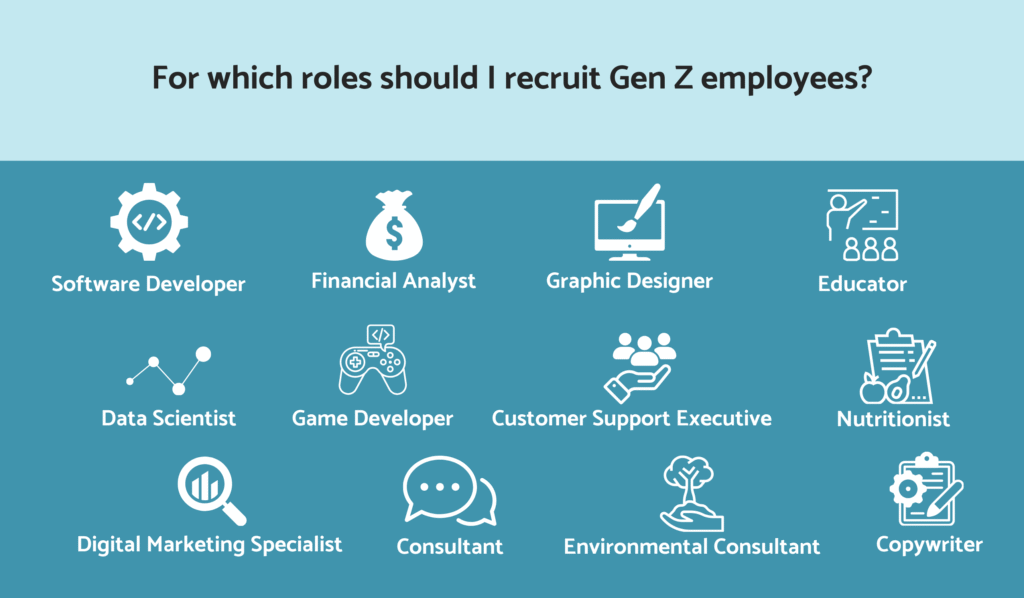
Roles that Gen Z employees excel in the workforce
- Software Engineer
- Data Analyst
- Digital Marketing Specialist
- Customer Support Executives
- Copywriter
- Nutritionist
- Game Developer
- Environmental Consultant
- Financial Analyst
- Education Consultant
- Consultant
- Graphic Designer
If you’re an employer unsure about how best to recruit Gen Z talent, get in touch with us. We’ll provide a free analysis of your recruitment needs to help you attract, assess, and retain the right Gen Z candidates for your organization.
Now, let’s look at the employers that prioritize Gen Z workers in the assessment process during their recruitment.
Which employers mandate an assessment process for their Gen Z employees?
Many employers across various industries utilize modern, digital assessment processes when recruiting Gen Z talent, as these methods evaluate candidates beyond traditional resumes and interviews. These assessments include personality tests, psychometric assessments, and situational judgment tests, game-based assessments, video interviews, and more.
Companies are increasingly recognizing the value of these tools in identifying candidates who not only possess the required skills but also align with the company’s culture and values.
Here is a list of the companies that offer a carefully-developed assessment process when recruiting Gen Z talent:
- Deloitte
- Microsoft
- Unilever
- PwC (PricewaterhouseCoopers)
- Accenture
- IBM
- KPMG
- EY (Ernst & Young)
- Salesforce
Many employers have shared their experiences with recruiting Gen Z in the workforce. Below, we highlight two case studies of employers who found Gen Z workers resourceful and efficient.
9. Leading Employers Successfully Recruiting Gen Z in the Workforce
Recruiting Gen Z into the workforce has proven beneficial to leading companies, as it fosters loyalty to the company at an early age, considering that employees’ needs are met within the organization.
Here are some real-world examples and case studies of two companies that demonstrate the impact of recruiting Gen Z.
1: Duolingo
Challenge: Duolingo’s TikTok presence was nearly nonexistent, and traditional marketing wasn’t engaging Gen Z users who were active on the platform.
Solution: Hired 23-year-old Zaria Parvez to run the TikTok channel with full creative freedom. She leaned into Gen Z humor and viral trends, using the Duo Owl mascot in quirky, authentic videos.
Results:
- Gained 8.2 million followers on TikTok
- Generated massive brand visibility and engagement
- Turned Duo Owl into a viral internet figure, boosting cultural relevance
- Strengthened brand appeal among Gen Z learners globally
2: Intch
Challenge: Intch, a job-matching tech startup, was struggling with low-performing ads and failing to connect with Gen Z users.
Solution: Hired a Gen Z marketer who overhauled their strategy using meme-style content, TikTok-inspired videos, and relatable messaging targeted at younger users.
Results:
- Boosted return on ad spend from 30% to 120%
- Quadrupled marketing efficiency
- Increased reach, engagement, and conversions
- Built a more authentic brand voice that Gen Z could relate to
This is now where the Assess Candidates platform comes in, assisting companies in ensuring that the assessment process goes smoothly.
10. Why do Companies Choose Assess Candidates for Their Gen Z Assessment Process?
As companies seek to hire Gen Z workers, the need for an effective and tailored assessment process becomes even clearer. Gen Z, born into a world of digital innovation, values fairness, transparency, and opportunities for personal and professional growth.
Traditional hiring methods, such as resumes and interviews, often fail to capture the full potential of Gen Z candidates, leading many companies to turn to specialized hiring platforms like Assess Candidates. This approach helps organizations evaluate applicants based on real-world tasks, soft skills, and competencies, providing a comprehensive view of a candidate’s abilities.
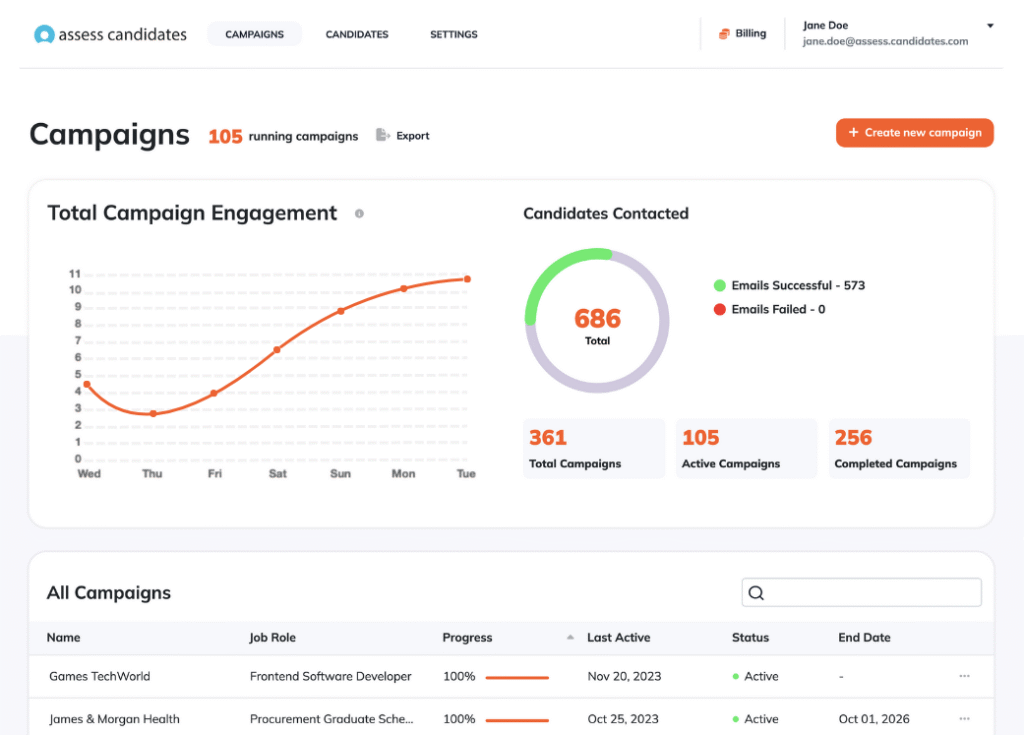
Assess Candidates streamlines the recruitment process by providing a data-driven, unbiased evaluation. This is especially important when hiring Gen Z, who expect a more modern, transparent, and equitable hiring experience. The platform enables companies to assess technical expertise, problem-solving skills, and adaptability, qualities that are essential in today’s fast-paced workplace.
For businesses seeking to attract top Gen Z talent, leveraging Assess Candidates ensures they are hiring individuals who not only fit the role but also align with the company’s values and culture.
Here are 5 reasons why employers prefer Assess Candidates when recruiting Gen Z workers:
- Objective Evaluation: Gen Z candidates are digital natives who value fairness. By using Assess Candidates, companies can evaluate their abilities without the bias that often accompanies traditional interview processes. The platform’s structured assessment process ensures that hiring decisions are based on objective data rather than subjective impressions.
- Skills Verification: Gen Z is known for its adaptability and desire to grow, but their skills may not always be accurately represented on paper. Assess Candidates helps companies verify their technical and soft skills in real-world scenarios, ensuring they’re equipped for the role and company culture.
- Predict Job Performance: With Assess Candidates, companies can predict how Gen Z applicants will perform in specific job environments. Whether it’s problem-solving, creativity, or collaboration, our hiring assessment portal helps determine whether candidates possess the qualities necessary for success in the role.
- Tailored for Specific Roles: The Assess Candidates platform allows companies to customize assessments based on the unique requirements of each role. For Gen Z candidates, who may have different expectations and skills from previous generations, this flexibility ensures that companies are assessing the exact competencies needed for success in the job.
- Enhances Candidate Experience: Gen Z seeks transparency and fairness in every step of the recruitment process. By using Assess Candidates, companies can offer a more engaging, straightforward, and fair hiring experience. Candidates feel that their abilities are being measured in a meaningful way, creating a positive impression of the company from the very beginning.
Discover trusted assessments created by Chartered Scientists to help you recruit the best Gen Z talent. VIEW PLANS
With our advanced platform, you can confidently attract and hire the best Gen Z talent. Explore our top hiring assessments and start making informed hiring decisions today!
Lastly, ever wondered what the future of Gen Z will look like? Let’s take a look at the possible outcomes.
11. What will Gen Z Recruitment Look Like in the Future?
The future of Gen Z recruitment will undoubtedly evolve over the years, driven by technology, shifting expectations, and changing work dynamics. Companies will need to adapt their recruitment strategies to meet the expectations of this tech-savvy generation, who value transparency, inclusivity, and a seamless digital experience.
What will define how companies recruit Gen Z talent in the future?
- Hyper-Personalized Recruitment
Gen Z expects personalized experiences at every touchpoint. Traditional, one-size-fits-all recruitment processes will be replaced by tailored experiences that speak to an individual’s unique skills, interests, and career goals.
- Social Media as a Primary Platform
While LinkedIn and Indeed remain important, Gen Z is increasingly active on TikTok, Instagram, and Twitter. To reach them, recruitment strategies should include short, engaging videos showcasing company culture, behind-the-scenes content, and employee stories. Using influencers or brand ambassadors to promote job openings can also help attract top Gen Z talent.
- Company Values and Purpose
Gen Z seeks meaningful work with transparent, value-driven employers. Companies must continue to clearly communicate their mission, culture, and commitment to issues like diversity, sustainability, mental health, and social responsibility to attract top talent.
- Hybrid and Remote Work Options
Gen Z values flexibility, making hybrid and remote work essential for attracting top talent. Companies that don’t offer flexible arrangements may struggle to recruit this generation. Additionally, Gen Z is tech-savvy and continues to prefer digital collaboration tools like Slack, Zoom, and Microsoft Teams for seamless communication and teamwork.
- Skills-Based Hiring
Gen Z prioritizes skills and practical experience over traditional degrees. Recruitment will increasingly focus on apprenticeships, bootcamps, and non-traditional pathways. Additionally, Gen Z values continuous learning, so companies that offer development opportunities will attract top candidates.
- Diversity and Inclusion
Generation Z expects employers to reflect the diversity they value, prompting companies to prioritize inclusive hiring practices across gender, race, and background. Additionally, the use of AI and other technologies to eliminate bias will be crucial, as Gen Z demands fairness and equality in the recruitment process.
- Data-Driven Decision Making
Data will play a crucial role in recruitment, with companies utilizing advanced analytics to track candidate pipelines, measure campaign effectiveness, and make informed hiring decisions. Additionally, by analyzing candidates’ online behaviors, companies can gain insights into their preferences, work habits, and cultural fit, enabling more targeted recruitment strategies.
Interested in learning more about the impact that Gen Z has in the workforce? Continue scrolling to learn more about the frequently asked questions, and sign up with your email to get started.
After reviewing the page, you may have some questions about recruiting Gen Z talent in 2025/26. Below, we have answered some frequently asked questions for you.
Frequently Asked Questions
What does Gen Z value most when choosing an employer?
Gen Z prioritizes purpose, flexibility, and inclusion. They are drawn to companies with clear values, transparency around social impact, and a culture that supports diversity, mental health, and work-life balance.
What role does technology play in recruiting Gen Z?
Technology is critical. Gen Z expects a mobile-friendly, fast, and digital-first hiring process. Tools like GenAI, automated assessments, and predictive analytics (e.g., behavioral data) help create a fair and efficient experience that aligns with their expectations.
How is Gen Z different from previous generations in the workplace?
Gen Z is the most tech-savvy, socially conscious, and entrepreneurial generation yet. Unlike millennials, they expect more autonomy, faster feedback, and a sense of career purpose from day one, not just job security or perks.
Why should companies invest in assessment platforms when hiring Gen Z?
Gen Z prefers transparent, skills-based evaluations, and platforms like Assess Candidates provide data-driven, bias-free assessments that give them a fair chance to demonstrate their potential, helping companies hire more effectively while improving the candidate experience.
How can employers retain Gen Z talent once hired?
Gen Z retention strategies revolve around purposeful work, career growth, and strong communication. Gen Z wants regular feedback, clear development paths, and a sense that their contributions are valued and matter. Fostering an inclusive culture, offering upskilling opportunities, and supporting mental health are key to keeping them engaged long-term.


 English
  Arabic