
How To Train Hiring Managers To Interview Better



Have you ever hired someone who seemed perfect on paper but didn’t succeed in the role? Or maybe you’ve seen strong candidates drop out because the interview experience felt inconsistent or unclear?
These issues are common, and they almost always point back to one thing: most hiring managers have never been properly trained to interview. Interviewing is often treated as a natural skill, when in reality it is learnt.
Just like workplace and hiring practices have evolved over time, interviews have moved away from intuition-led, informal chats to data-driven, structured, competency-based interviews supported by research-backed methods like behavioral interviewing and the STAR method.
Structured interviews have much better predictive validity than unstructured interviews. Meta-analyses estimate a validity coefficient around 0.44 for structured interviews compared to 0.33 for unstructured ones, making structured approaches about 33% more effective at predicting future job performance.
Modern organizations recognize that effective interviewing directly impacts team performance, fairness, and long-term retention. But they must still provide hiring managers with the right training, practical guidance, and tools.
This guide shows you how to train hiring managers to interview more effectively, reduce interview bias, strengthen the candidate experience, and use structured interviewing to make fairer, more confident hiring decisions.
Contents
- Why Interview Training for Hiring Managers Matters
- Essential Interview Skills Every Hiring Manager Needs to Succeed
- How to Train Hiring Managers to Interview Effectively: Practical Examples
- Top Tools and Resources for Hiring Manager Interview Training
1. Why Interview Training for Hiring Managers Matters
Hiring managers play a critical role in recruitment outcomes, influencing who gets hired, the candidate experience, and long-term retention.
Yet many organizations expect hiring managers to interview effectively without ever being formally trained. This often leads to inconsistent evaluations, biased decision-making, and hiring outcomes that weaken team performance and business results.
By equipping recruiting managers with structured training and expertise, organizations are able to boost the quality of their hires and create a more consistent, fairer, and positive experience for candidates.
Below, we will look at the key benefits that interview training brings to both hiring managers and the wider company.
Advantages of Interview Training for Hiring Managers
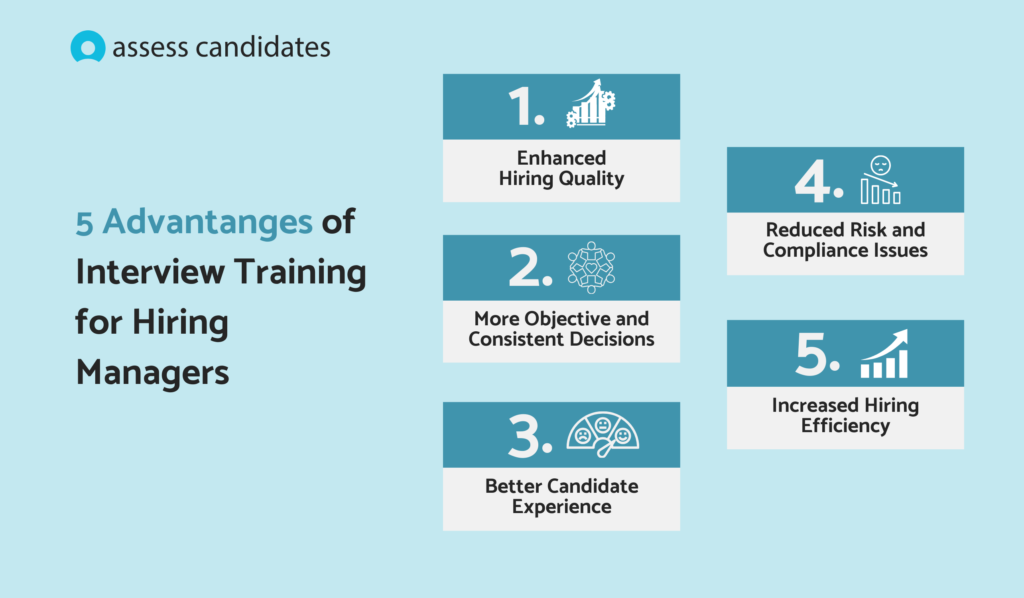
- Enhanced Hiring Quality: Structured interviews are effective in providing quality hiring results as they help recruiters focus on job-relevant skills and behaviors rather than intuition. Research from Greenhouse showed that organizations using structured interviewing saw measurable improvements in long-term performance and quality of hire.
- More Objective and Consistent Decisions: Interview training decreases personal bias and guesswork. Managers are taught how to assess each applicant with the same criteria and scoring framework. This makes candidate comparisons fairer and more reliable.
- Better Candidate Experience: Candidates notice when interviews are organized, transparent, and respectful. Well-trained interviewers introduce the company professionally, communicate clearly, and create a positive impression that supports employer branding.
- Reduced Risk and Compliance Issues: Untrained interviewers may ask legally risky or inappropriate questions without realizing. Training will avoid any discriminatory practices, help managers know what to ask and avoid, and cushion the organization against a possible legal liability.
- Increased Hiring Efficiency: When hiring managers know exactly what they are doing and how to evaluate responses effectively, interviews become more efficient, faster, and focused. This results in reduced time-to-hire and reduced operational strain.
Use our data-driven, structured assessments and video interviews to make hiring simple. HIRE FOR FREE
Common Problems When Hiring Managers Lack Interview Training
- Subjective and Inconsistent Interviews
Without training, managers often rely on gut feelings or personal impressions. This causes unstructured interviews, inconsistent questioning, and unfair comparisons of candidates.
- High Cost of Poor Hiring Decisions
A bad mis-hire can cost you between 1.5-2 times their yearly salary, including recruitment costs, lost productivity, and onboarding. Structured interview training reduces this risk as hiring decisions become better and justified.
- Personality Over Competence
Without clear criteria, managers might prioritize superficial personality considerations instead of actual skills and job performance. This minimizes your chances of selecting the right candidates for your role.
- Unconscious Prejudice in Scoring
Personal biases during candidate evaluation may be introduced unconsciously and influence scoring and judgment if interviewers aren’t trained to mitigate them. This can unintentionally undermine equality and exclude the best talent.
- Ineffective Questioning and Evaluation Habits
Untrained managers tend to ask ambiguous or irrelevant questions, record inconsistent notes, and do not have a standardized rubric. This does not allow for accurate evaluation of the candidates’ competencies.
- Negative Candidate Experience and Compliance Risks
Candidates may walk away disoriented or underestimated during an interview, damaging your employer brand. Unpredictable procedures also increase the threats of legal or compliance problems in the organization.
Greenhouse indicates that 54% of applicants have been subjected to discriminatory interview questions, proving the risk of inexperienced interviewers. They also revealed that structured interviewing increased quality hires by 20%, demonstrating that interviewer training is worth the cost.
It is not enough to simply know why interview training is important. To interview effectively, hiring managers are required to have a specific set of essential skills that ensure fairness, consistency, and the ability to accurately evaluate candidates. In the next section, we explore the essential interview skills every hiring manager needs.

2. Essential Interview Skills Every Hiring Manager Needs to Succeed
The best training for hiring managers centers around skills, not just theory. Your goal is to equip your team with the right toolkit and abilities to run confident, fair, job-relevant interviews.
The following are the essential skills that a hiring manager must have:
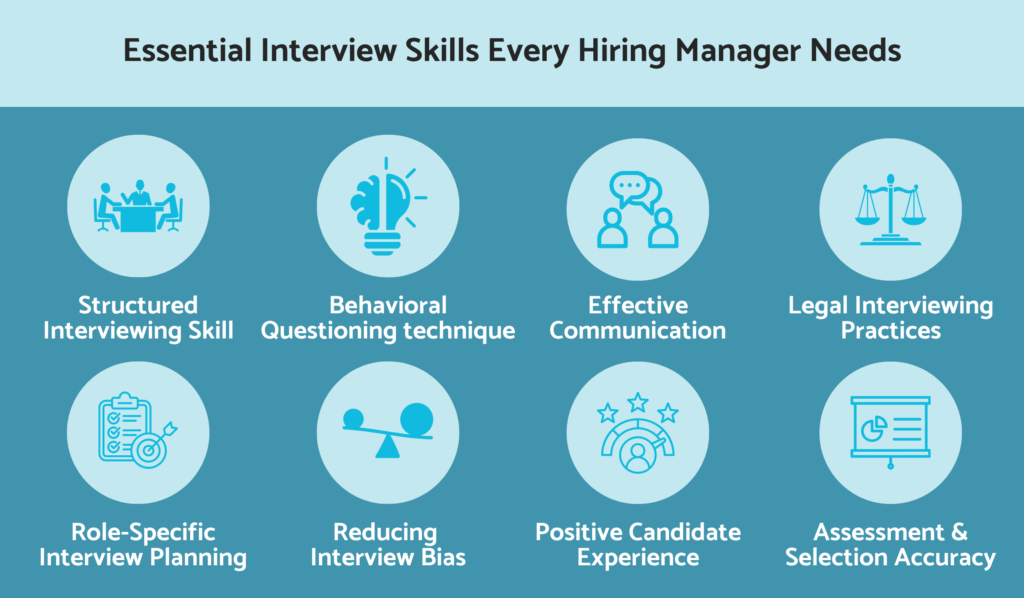
Structured Interviewing Skill
Hiring managers should be able to:
- Adhere to a well-defined interview plan
- Use standard questions and evaluation criteria
- Use interview scorecards and rubrics to ensure fairness
- Focus solely on job-related skills and competencies
This makes objective comparison possible, reduces variability, and ensures fairness for candidates.
Role-Specific Interview Planning
Managers need to learn how to:
- Examine the Knowledge, Skills, and Abilities (KSAs) and competencies for the position
- Tailor questions to job specifications
- Prepare tailored behavioral/situational questions
- Ensure candidates speak 80% of the time to reveal real capability
Adequate preparation will lead to accurate decisions during the interview process and whole candidate evaluation.
Behavioral Questioning Technique
Managers should be trained to:
- Ask questions that reveal actual past actions and behaviours
- Structure evidence-based responses with the STAR technique
- Probe for clarity instead of accepting unclear answers
- Assess objectively using a given rubric
One of the best predictors of future performance is behavioral interviewing.
Reducing Interview Bias
Hiring managers ought to know:
- How unconscious bias shows up in decision-making
- Ways to remain consistent using structured frameworks
- How scorecards decrease individual preference or “gut feeling”
- Techniques to focus on ability instead of character
Bias awareness and structured assessment have a positive impact on improved hiring practices, as well as enhancing diversity and inclusion throughout your company.
Effective Candidate Communication
Managers should master:
- Active listening techniques like summarizing and reflecting
- Polite communication that builds rapport
- Clear expectations and interview flow
- Picking up and responding to non-verbal cues
Strong communication improves candidate engagement and the quality of information gathered.
Delivering a Positive Candidate Experience
Managers must learn how to:
- Create a comfortable atmosphere
- Be transparent before, during, and after interviews
- Be a good representative of the company’s mission, values, and culture
- Make the interview feel like a conversation, not an interrogation
Candidate experience directly impacts employer brand and offer acceptance rates.
Legal & Compliant Interviewing Practices
Managers need guidance on:
- What questions are prohibited or discriminatory
- The impact of the protected characteristics on compliance
- Ways to make interviews fair and job-relevant
- The role of documentation as a protective measure for the organization.
Compliance training eliminates risk and assists in ethical interviewing.
Assessment & Selection Accuracy
Hiring managers should know how to:
- Make consistent competency-based notes
- Evaluate important skills such as problem-solving and teamwork
- Use evidence and not intuition to evaluate candidates
- Choose the best applicants based on systematic selection criteria
This boosts confidence in hiring and enhances employee performance in the long run.
The better the skill foundation, the more confident and consistent your hiring managers will be.
Equip your hiring managers with the necessary skills to interview effectively. CONTACT US
Putting the required skills into practice through hands-on training is just as important as learning them. Let’s discuss the practical approaches that will enable recruiting managers to put these skills to use during any interview.
3. How to Train Hiring Managers to Interview Effectively: Practical Examples
One of the most effective ways to improve hiring quality is to train hiring managers to interview effectively. This section outlines practical, evidence-based methods from SHRM, Greenhouse, Harvard Business Review, and other proven hiring models to help managers interview with confidence, consistency, and fairness.
Practical methods to train hiring managers to interview
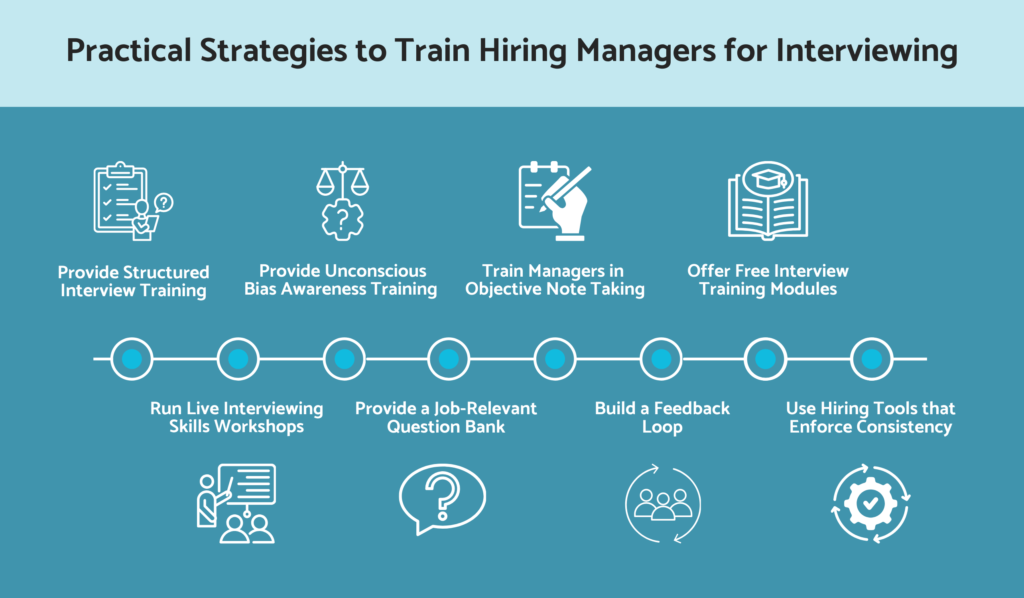
Provide Structured Interview Training
Training should start with the fundamentals, which involve educating managers on the need to adhere to a straightforward interview procedure that is structured and consistent. Structure removes speculation and provides all applicants a fair and equal assessment.
Apply a standardized approach by providing:
- Interview templates
- A question bank
- Evaluation rubrics
- Scorecards
This boosts confidence, enhances quality, and minimizes inter-team inconsistency.
Run Live Interviewing Skills Workshops
Workshops give managers the opportunity to practice interviewing in a realistic environment that is supportive. They assist in transforming the theory into practicalities through the use of coaching, demonstrations, and repetition.
Focus on:
- Interviewer skills training
- Interview technique training
- Behavioral interview training
- Competency-based interview training
- STAR method interview training
- Interview question training for managers
Add role plays, simulated interviews and live feedback to establish competence in a short period of time.
Provide Unconscious Bias Awareness Training
Bias training helps recruiting managers become aware of the influence of personal assumptions on judgments. Together with systematic methods, it leads to fairer, compliant, and more consistent decisions.
Show managers:
- How bias shows up
- What patterns to avoid
- Ways structured scoring minimizes bias
- How to focus on job-relevant cues
Add this with diversity training for hiring managers to strengthen inclusive hiring.
Provide a Job-Relevant Interview Question Bank
An efficient question bank helps keep interviews aligned to the role and eliminates unlawful or unrelated questions. It also ensures consistency across teams and recruitment.
For training, you should provide:
- Questions for behavioral interviews
- Technical and role-related questions
- Cultural fit questions
- Scenario questions
This promotes order, equity, and lawfulness.
Ensure better interviews with our structured interview question bank and reliable video interview platform. LEARN MORE
Train Managers in Objective Note Taking
Interviews are more valid and well-justified with solid notes. Hiring decisions are less biased when training managers are asked to make written, formal, and objective observations.
Teach them to document:
- Evidence-based notes
- STAR-aligned answers
- Meaningful observations
- Scorecard reasons
This generates valid comparisons of applicants and strengthens your recruitment.
Build a Feedback Loop
Interviewing is a skill that can be honed through review, coaching, and reflection. A feedback loop is used to make sure that managers do not become stagnant or dependent on the things they have always done but instead continue to grow.
Every hiring manager should:
- Receive feedback from recruiters
- Be evaluated on scoring accuracy
- Review interviews with peers
This brings about sustained development rather than a one-off training.
Offer Free Interview Training Modules
Not all training requires a budget. A large percentage of organizations establish strong interview skills through free interviewing software, video, and in-house learning platforms.
Many teams use:
- Free Greenhouse hiring manager training
- Free interviewer skills training videos
- Internal LMS modules
These resources support accessible and scalable interviewer development.
Use Hiring Tools That Enforce Consistency
Technology assists managers to conduct organized, fair, and quality interviews. Tools guide them through questions, scoring, and evaluation criteria. There are tools that direct hiring managers in questions, scoring, and assessment criteria.
Some useful ones include:
- Assess Candidates video interview tool
- Greenhouse structured hiring
- Lever interview plan
- Workable structured interviews
- SHRM interview templates
These platforms minimize variance and assist managers in making evidence-based decisions.
Discover proven, standardized techniques to train hiring managers effectively. HIRE FOR FREE
Interview training is best facilitated with the appropriate tools. Now, let’s look at some resources that enhance the learning process and enable hiring managers to interview candidates with confidence and consistency.
4. Top Tools and Resources for Hiring Manager Interview Training
Equipping hiring managers with the appropriate tools makes interview training more productive, reliable, and quantifiable. The right platforms support structured interviewing, reduce bias, improve candidate experience, and enable data-driven hiring decisions.
What are the leading tools for recruiter interview training
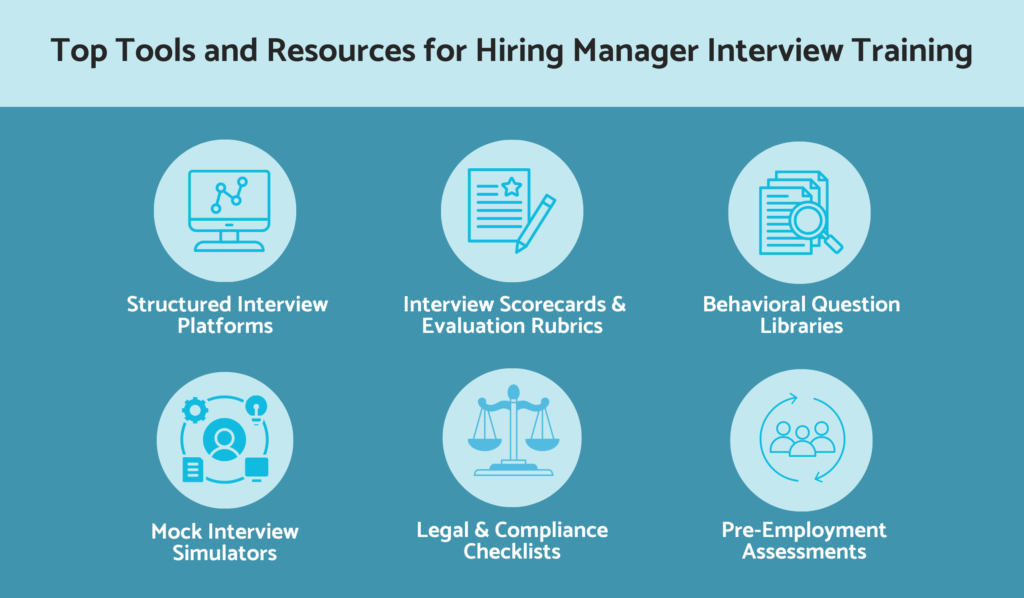
- Structured Interview Platforms
Structured interview platforms such as Greenhouse, Lever, Assess Candidates, and Workable allow hiring managers to follow a uniform approach during every interview. They provide:
- Role-specific, behavior-based question banks
- Rating scales to measure responses
- Interview Scorecards & Evaluation Rubrics
Scorecards and rubrics ensure fairness and objectivity in evaluations across all candidates. They help managers:
- Evaluate consistently across interviews
- Focus on job-related competencies
- Compare candidates based on evidence, not “gut feeling”
This minimizes guesswork, and also increases reliability in employment decisions.
- Behavioral Question Libraries
Behavioral and competency-based question libraries help recruiting managers design and ask questions that highlight real-world skills and experiences. They cover:
- Behavioral questions
- Competency-based assessments
- Prompts based on situations or scenarios
These help uncover the way candidates have coped with difficulties in the past and their workplace performance.
- Mock Interview Simulators
Simulated interviews help managers practise and prepare for real-world interviews prior to interviewing actual applicants. This improves confidence, offers consistency, and reinforces effective questioning procedures.
- Legal & Compliance Checklists
Checklists enable recruiting managers to avoid making mistakes that can put them at a legal risk. They include:
- Discriminatory or unsuitable questions
- Non-compliant topics
- Risky wording or suppositions
This is to make sure that interviews are fair, respectful and not against the law.
- Pre-Employment Assessments
Pre-employment assessments are an objective, accurate, and reliable way to assess the skills and strengths of candidates.
Scientifically designed assessments include:
- Cognitive ability tests
- Personality tests
- Situational judgment tests
- Video Interviews
- Coding tests
- Job simulation tasks
- Job-specific skills tests
At Assess Candidates, we recommend combining these tests with structured interviews in your hiring process to:
- Evaluate relevant skills appropriately
- Enhance objective and fair assessment
- Improve overall recruitment processes
Enhance your recruitment process with data-driven assessments that deliver quality employees. Learn More
Conclusion: Key Takeaway
When you train hiring managers to conduct better interviews, you strengthen every part of your hiring process, including candidate experience, decision quality, fairness, team performance, and long-term organizational success.
Interview training is not a one-time event. It is an unceasing process, which is supported by systematic tools, frequent feedback, and planned learning. Once hiring managers possess the appropriate skills (behavioral interviewing, structured interviews, STAR method, bias reduction, scorecards, and competency mapping), they make hiring decisions clearly and confidently.
Better interviewers build better teams. And better teams build better companies.
Interested in learning more about how to improve your hiring process and acquire more effective interview skills in your team? Read on to answer the commonly posed questions on interview training for hiring managers.
Frequently Asked Questions
Why should hiring managers receive interview training?
Hiring manager interview training enhances the consistency of interviews, reduces unconscious bias, enhances the candidate experiences, and improves the quality of hires which leads to better performance and retention of the team.
What skills do hiring managers gain from interview training?
Managers develop structured interviewing, behavioral interviewing, STAR method, note-taking, objective analysis, legal compliance, and competency-based hiring skills.
Can interview training reduce hiring bias?
Yes. Training managers in unconscious bias, diversity and inclusion, and structured evaluation methods substantially reduces bias and enhances equitable hiring decisions.
Are there free resources for hiring manager training?
Yes. Different platforms such as Greenhouse, SHRM, and LinkedIn Learning offer free modules and guides for interview skills training, structured interviewing, and behavioral interview techniques.
How often should hiring managers receive training?
Training should be ongoing. Continuously develop interviewer skills through feedback loops, refresher courses, mock interviews, and peer reviews to maintain consistency in hiring.
What is the effect of interview training on candidate experience?
Trained managers run organized, respectful, and consistent interviews. This makes the candidates feel important, educated, and relaxed, which improves the employer brand of the company.


 English
  Arabic